
For years, fluorinated DWR finishes were the easy way to make fabric shed water. They worked very well, but the chemicals behind them, PFAS, barely break down in the environment and have earned the name “forever chemicals”. In 2026 regulators and brands have turned that concern into hard rules, and for outerwear, workwear and bag fabrics PFAS-free is no longer a bonus. It is a condition of doing business.
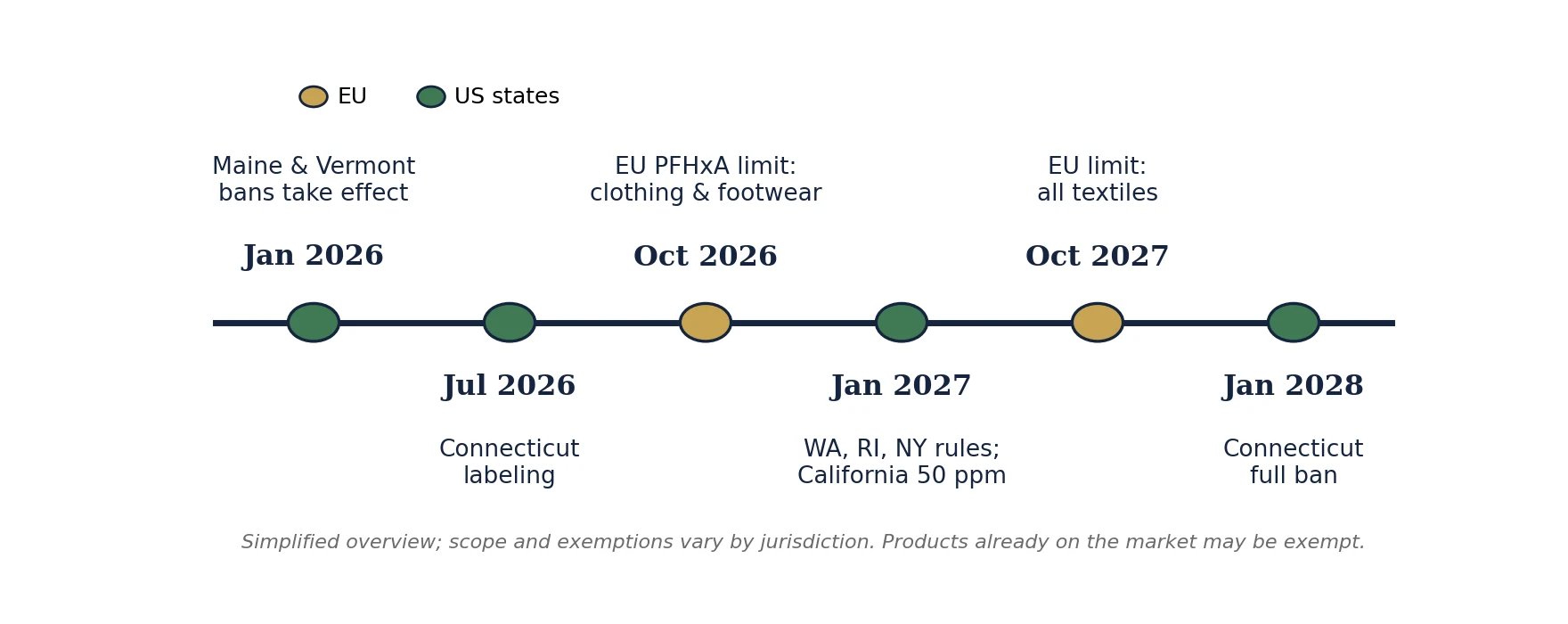
What changed in 2026
- European Union. Under REACH, limits on PFHxA and related substances apply to clothing textiles and footwear from 10 October 2026, and extend to other textiles from 10 October 2027. Some PPE is excluded.
- United States. Several states now restrict textiles with intentionally added PFAS. Maine and Vermont from January 2026, Connecticut with labeling from July 2026 and a ban from 2028, and Washington, Rhode Island and New York from 2027. California tightens its total organic fluorine threshold to 50 ppm in 2027.
- Brands. Most major outdoor and fashion brands already require PFAS-free chemistry in their restricted substances lists, often ahead of the law.
PFAS-free options available today
There is no single replacement for fluorinated DWR. Commercial finishes follow four main routes:
- Hydrocarbon and wax-based. The most widely used today, with good water repellency and a soft hand.
- Silicone-based. Strong water beading and a smooth hand, popular on lightweight shells.
- Bio-based. Repellents made partly from renewable raw materials, attractive for brands with bio-based content targets.
- Structural or biomimetic. Repellency created by surface texture rather than chemistry, like a lotus leaf. Still mostly at research stage.
One honest trade-off: PFAS-free finishes repel water well but generally don’t repel oil and grease the way fluorinated finishes did. If your product needs oil or chemical-splash repellency, discuss it early, because that requirement shapes the whole fabric and finish choice.
Two approaches to watch
Structure instead of chemistry. In September 2026, researchers at Kyoto University reported in Nature a foaming photolithography method that creates microscopic pores inside a polymer. The structure scatters light to produce a bright white without titanium dioxide pigment, and makes the surface strongly water-repellent without PFAS. It has been demonstrated on fabric but is still at the research stage. Its significance is that it shows performance could one day come from the material’s structure rather than from a chemical finish.
Seaweed-based repellents. In August 2026 the European Commission’s maritime affairs directorate highlighted Algae Scope, an Italian start-up turning seaweed processing by-products into particles that form a protective, water-repellent layer on fibers, aimed at replacing fluorinated DWR in outdoor and protective textiles. It is an early-stage technology, but it points to repellents that can carry bio-based and low-carbon claims.
Neither is something to put into a 2027 bulk order. Both show where the industry is heading: more than one PFAS-free route, each with its own strengths.
How to verify a fabric is PFAS-free
- Ask for the finish chemistry declaration naming the DWR product used, not just a “PFC-free” label.
- Request a test report. Depending on the market, that may be targeted PFAS analysis or a total fluorine screen.
- Test performance before and after washing. A spray rating (ISO 4920 or AATCC 22) on new fabric and after your wash protocol tells you how durable the finish really is.
- Specify the care instructions. Many PFAS-free finishes recover much of their beading after tumble-drying or ironing on low heat. Telling end users this improves real-world performance.
At Yongbo Textile, PFAS-free DWR is applied on our own finishing lines across our outerwear and workwear range, including nylon ripstop, coated polyester, nylon taslon and recycled polyester and nylon. We document the finish chemistry per order and test water repellency before and after washing against your target. Tell us your end use and market and we will recommend the finish route that fits. 🌐 yongbotex.com
Further reading: Beveridge & Diamond on the EU PFHxA limits and US state rules · Kyoto University research release · Algae Scope coverage
Frequently asked questions
What is PFAS-free DWR?
A durable water-repellent finish made without per- and polyfluoroalkyl substances. Common types are hydrocarbon or wax-based, silicone-based and bio-based repellents.
When do the EU PFAS restrictions for textiles apply?
Under REACH, the PFHxA limits apply to clothing textiles, related accessories and footwear for the general public from 10 October 2026, and to other textiles from 10 October 2027. Some PPE is excluded.
Is PFAS-free DWR as good as fluorinated DWR?
For water repellency, modern PFAS-free finishes perform well. They generally do not repel oil and grease as well as fluorinated finishes, so products that need oil or chemical-splash repellency need careful fabric and finish selection.
How can I verify a fabric is PFAS-free?
Ask the mill for the DWR product declaration, a test report (targeted PFAS analysis or total fluorine, depending on your market), and a spray rating such as ISO 4920 or AATCC 22 before and after your wash protocol.