Two polyester fabrics can carry the identical yarn count and the identical construction, yet one reads quietly expensive while the other looks shiny and cheap. Buyers often chalk this up to “luster” and simply write matte finish on the order — then bulk arrives too glossy or too grey against the sample, with no obvious explanation. The explanation is a white powder called titanium dioxide, and the decision is made at the fiber stage, long before anyone weaves or dyes.
Luster is set at the spinneret, not in finishing
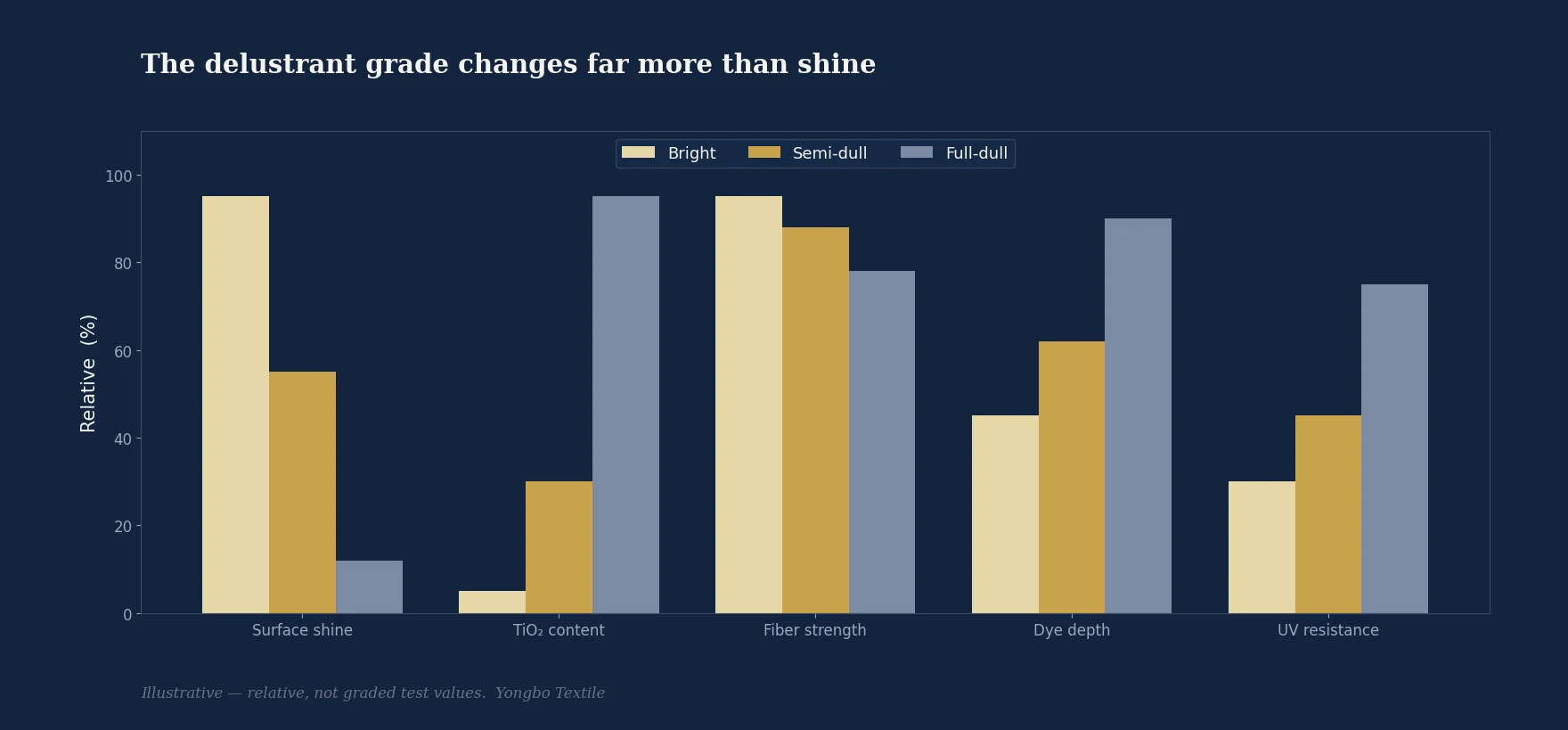
When polyester is spun, a delustrant — titanium dioxide (TiO₂) — can be blended into the melt. Its refractive index is much higher than the polymer around it, so light passing through the filament scatters instead of bouncing back as a clean reflection. More TiO₂ means less shine. Because the powder is locked inside the fiber, the luster grade is baked in from birth and can’t be genuinely converted afterward.
The three grades are three different materials
- Bright — no delustrant. A smooth, strongly reflective filament; the fabric looks glossy, crisp, a little plastic, and visibly shines under store lighting.
- Semi-dull — a small amount of TiO₂. A soft residual luster with a faint sparkle. This is the default commodity grade and the majority of polyester on the market.
- Full-dull — roughly eight to ten times the semi-dull loading of TiO₂. Light is almost entirely scattered, leaving a calm, even matte with no glint.
An order-of-magnitude gap in delustrant content is not a “finish adjustment” — these are three distinct material systems, and you choose one at the yarn stage.
What travels with the luster
Because TiO₂ is a solid particle embedded in the fiber, it changes more than appearance:
- Strength. More particles mean more internal stress points, so full-dull filament is inherently a little weaker than semi-dull. The particles also wear on spinnerets during production, raising breakage and cost — full-dull yarn is pricier because it’s genuinely harder to make, not for marketing reasons.
- Dye depth. The rougher, higher-surface-area full-dull fiber takes dye more deeply, so the same black recipe comes out blacker and richer, while semi-dull reads slightly brighter and more transparent. This is the same surface-area effect that governs how blends and fibers take color. For deep, premium colorways, full-dull is the better base.
- UV performance. TiO₂ scatters ultraviolet light, so full-dull polyester starts with better UV resistance than bright — a head start for sun-protective fabrics before any UV finish is added.
Three traps this catches buyers in
Accepting “matte” that’s really a finish. Some suppliers deliver semi-dull cloth given a chemical delustering treatment, or even bright yarn treated after weaving. It looks matte at handover — then the shine creeps back after a few washes as the auxiliary rinses out. True full-dull is matte at the fiber level and can’t wash out. Ask whether the delustrant is in the yarn, and get the yarn grade stated on the spec.
Running dark colors on semi-dull. Black, navy and deep brown on a semi-dull base look shiny, shallow and inexpensive no matter how carefully they’re dyed. Dark programs belong on full-dull. The reverse holds too: pale and vivid shades on full-dull can go grey and flat.
Ignoring the strength penalty on lightweight styles. Because full-dull fiber is weaker, thin constructions — pongee weights, chiffon-weight wovens — lose tear and abrasion resistance at the same weight. On lightweight full-dull, confirm tear-strength targets up front so construction can be tuned to compensate.
What to specify instead of “matte”
Name the grade — bright, semi-dull or full-dull — and ask for the yarn grade on the spec sheet rather than a finish description. Match your shade plan to the grade before you commit lab dips: dark and premium on full-dull, bright and pale on semi-dull or bright. Doing that check before dips saves a round of rejected samples — the same logic behind specifying color properly with a mill.
At Yongbo Textile, we quote full-dull with the delustrant in the yarn and state the yarn grade on the spec so you can verify it, rather than delustering by finish. Shade is checked against the delustering grade before lab dips, and tear strength on lightweight full-dull is tested per order in our ISO 17025 lab — so matte ships matte, and stays that way. 🌐 yongbotex.com