Ask a mill to dye a single-fiber fabric and the answer is fairly routine. Ask them to dye a blend — and the quote, the shade risk and the lead time all change, because now two fibers with two incompatible dye chemistries have to be colored inside one piece of cloth. Most modern fabrics are blends, so this is where dyeing quotes are actually won or lost. Below is what the reconciliation looks like, and the questions that tell you whether a dyehouse can really handle it.
First, the one-line recap: each fiber has its own dye class
Before blends, the baseline: a fiber can only be dyed with the dye class that bonds to it. Cotton, viscose and Tencel take reactive dyes; polyester takes disperse dyes at around 130°C under pressure; nylon, wool and silk take acid dyes; acrylic takes cationic dyes; and premium high-fastness cotton uses vat dyes, with sulfur at the economy end. Each brings its own temperature, pH and fastness profile. We’ve laid that mapping out in full — and what it means for how color survives washing — in our guide to why dye type decides colorfastness. Here we build on it, because the interesting engineering starts when you put two of these fibers together.
Why a blend is harder than the sum of its fibers
The trouble is that the two dye systems often want opposite conditions. Cotton’s reactive dyeing fixes in alkali (around pH 10–11); nylon’s acid dyeing wants acid (around pH 4). Polyester needs 130°C; some fibers can’t survive anywhere near that. So a mill has to either run two separate baths — clean, controllable, but longer and more expensive — or squeeze both systems into fewer steps and accept a narrower process window. That single choice ripples straight into your price and schedule.
The blends you’ll actually be quoting
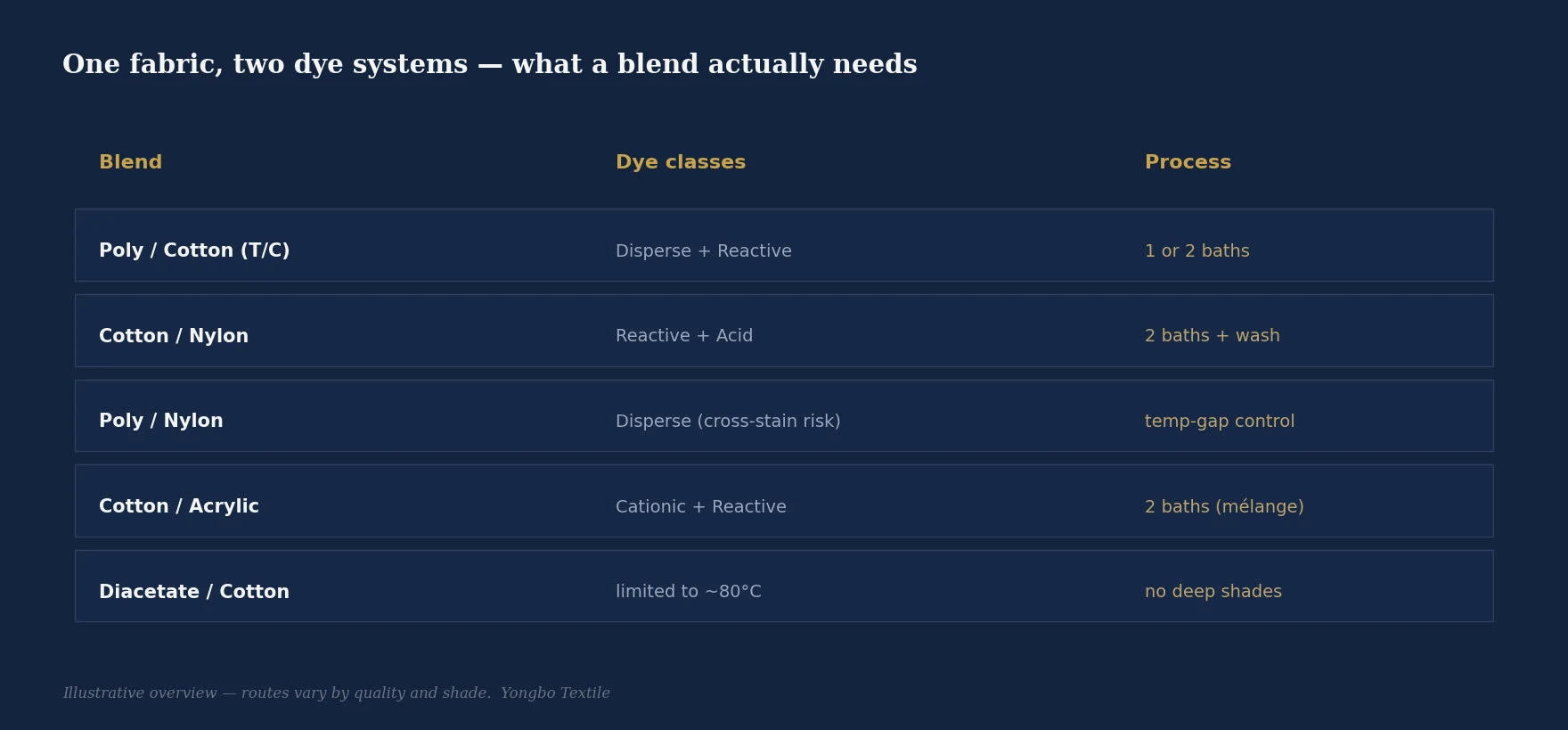
Poly/cotton (T/C). Disperse for the polyester, reactive for the cotton. It’s done either two-bath (fully separate — best shade control, higher cost) or one-bath two-step (cheaper, tighter window, slightly less fastness headroom). If a quote just says “one bath,” the sharp follow-up is: one step or two? True simultaneous one-bath dyeing on T/C is genuinely difficult and beyond most commodity dyehouses.
Cotton/nylon. Acid for the nylon, reactive for the cotton — and the pH conflict (acid vs alkali) means this almost always needs two baths with a careful wash in between. If acid liquor carries over into the alkaline bath, both sides suffer. Longer process, higher cost, longer lead time, and dark shades take dedicated matching because the two fibers absorb differently.
Poly/nylon. The hidden trap is cross-staining: disperse dye meant for polyester also tints the nylon. It’s managed by working the temperature gap between the two systems, or with anti-staining steps on better qualities — either way it’s process work, not a default.
Cotton/acrylic. Cationic first under acid conditions, then a wash, then reactive under alkali. The heathered, mélange looks this blend is known for are the two fibers deliberately taking different color — that’s design, not a defect.
Acetate blends. One question decides everything: diacetate or triacetate? Triacetate handles 120–130°C and can go deep like polyester; diacetate can’t exceed roughly 80°C, which means a diacetate/cotton blend physically can’t be dyed to a deep shade. If a supplier promises dark diacetate, either the fabric actually contains polyester, the shade will land light, or something’s off. Ask for the acetate type and percentage before you accept a quote.
What this changes in your quote and your calendar
Two things follow directly. First, dyeing cost tracks process length — every extra bath, wash and controlled temperature step adds cost and time, so a blend that needs two baths and an intermediate wash will never price like a single-fiber fabric. Second, compare quotes within one production region and with the dye route named. Regional capacity swings pricing hard: around our base in the Jiaxing–Shaoxing cluster, polyester dyeing capacity is dense and competitive, so polyester processing can cost less than cotton here — the opposite of what you’d see where capacity is thin. A quote without the dye route stated isn’t really comparable.
Questions that separate a real dyehouse from a job shop
For any blend, three questions do the work: Which dye class goes on each fiber, and how many baths? For an acetate blend, is it diacetate or triacetate, and at what percentage? Can you match and shade this in-house, or is dyeing subcontracted? A mill that dyes blends routinely will answer without flinching; hesitation on any of them tells you where the risk is.
At Yongbo Textile, cotton, T/C and polyester are dyed and finished on our own lines in Jiaxing, with stable, traceable recipes — including controlled two-bath work on blends where shade consistency depends on it. Wash, rub and light fastness are tested per order in our ISO 17025 lab, so blend shades ship matched and documented rather than hoped-for. 🌐 yongbotex.com