When a buyer asks “will this color hold up?”, the honest answer starts with a question most tech packs never mention: what class of dye was used? Different dye chemistries bond to fiber in completely different ways — and that bond, more than almost anything else, decides how color behaves through washing, rubbing and sunlight.
You don’t need a chemistry degree to buy fabric well. But knowing the handful of dye classes that matter for your fiber helps you ask sharper questions and understand why two “same color” fabrics can perform very differently.
The dye classes that matter for cotton and cellulose
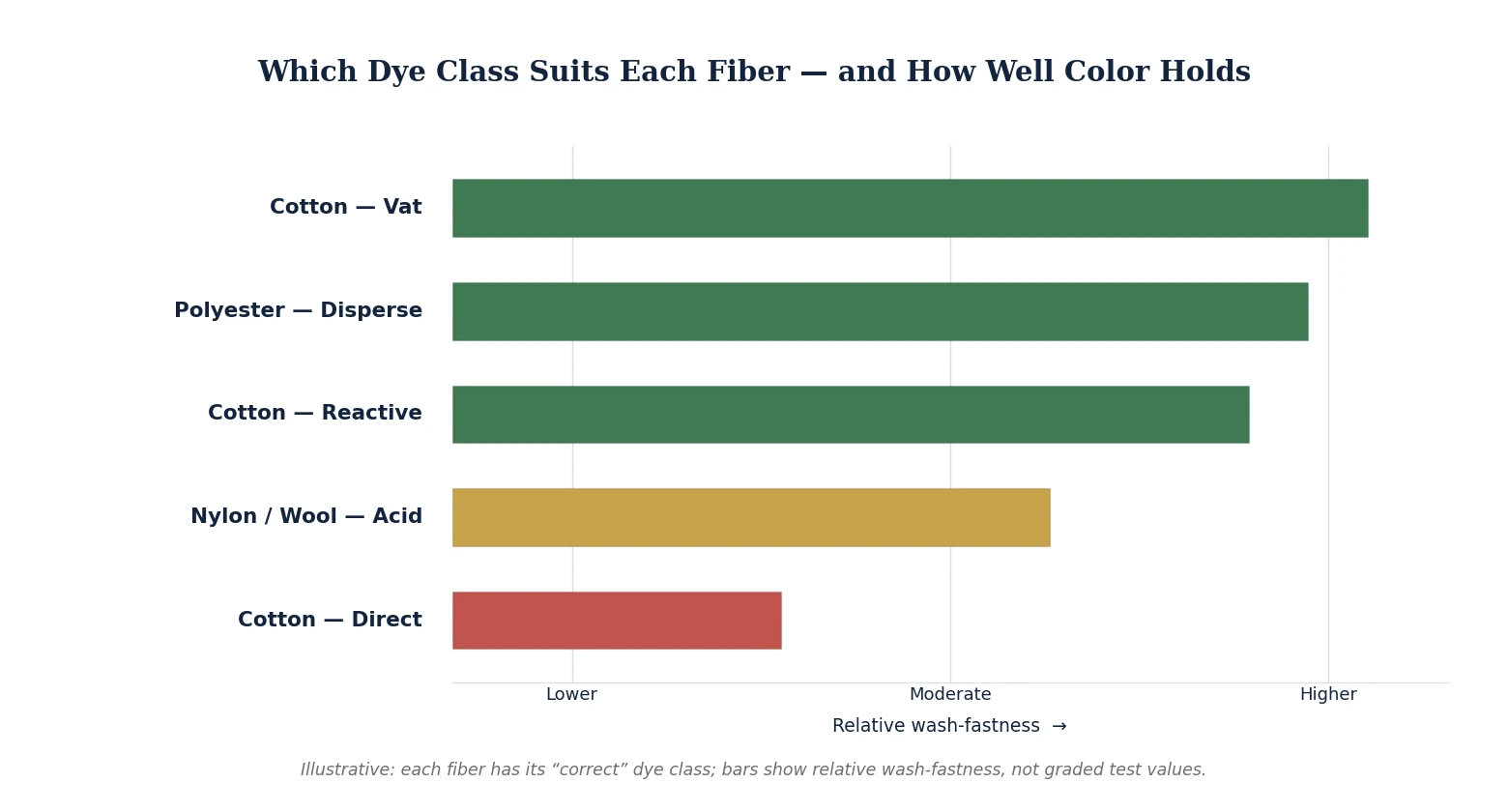
Reactive dyes are today’s workhorse for cotton. They form a true covalent bond with the fiber — chemically becoming part of it — which is why reactive-dyed cotton generally delivers the best wash-fastness for everyday apparel. If you’re ordering cotton workwear or shirting and colorfastness matters, reactive dyeing is usually what you want to hear.
Vat dyes are the premium option for cotton where fastness demands are extreme. They’re insoluble pigments that get chemically reduced, absorbed into the fiber, then oxidized back to insoluble form — locked inside the fiber. Vat-dyed fabric leads in wash- and light-fastness, which is why it shows up in uniforms and workwear that face industrial laundering. The trade-off: a more demanding process and higher cost.
Direct and sulfur dyes sit at the economy end. Direct dyes attach only by weak physical forces, so wash-fastness is limited — acceptable for linings or low-wash items, risky for garments washed often. Sulfur dyes (common for deep blacks and navies) are inexpensive and reasonably fast, but need careful process control to avoid harsh hand or, over time, fiber damage.
Synthetic fibers play by different rules
Polyester takes disperse dyes — tiny, water-insoluble particles that dissolve into the fiber itself under high temperature. This is why polyester holds color so stubbornly, and also why it can’t simply be dyed in the same bath as cotton: a T/C 65/35 fabric is typically dyed in a two-step process (disperse for the polyester, reactive for the cotton), which is part of why blend dyeing demands more from a mill than single-fiber dyeing — and why blends drive dyeing cost and lead time the way they do.
Nylon and wool generally take acid dyes, which bond ionically to the fiber’s amino groups; acrylic takes cationic dyes. For buyers, the practical takeaway is simple: each fiber has its “correct” dye class, and a mill that quotes suspiciously cheap dyeing on a blend may be cutting corners on one side of the process.
What this means when you place an order
Three practical questions cover most situations. First, ask which dye class will be used for your fabric and fiber — for cotton, “reactive” is the standard answer, and “vat” the premium one for industrial-wash programs. Second, tie it to numbers: request colorfastness ratings (wash, rub, light — graded 1–5) on the actual finished fabric rather than accepting general assurances. Third, for blends like T/C, confirm the mill controls both stages of the two-bath process in-house — that’s where shade consistency between batches is won or lost. Once fastness is settled, how you actually specify and approve the color is the other half of getting shade right.
At Yongbo Textile, dyeing runs on our own lines with recipe traceability — reactive and vat processes for cotton, disperse for polyester, and controlled two-bath dyeing for T/C blends, with fastness tested per order. 🌐 yongbotex.com