When finished garments come back from the first wash a size smaller, or with twisted side seams, the pattern usually gets the blame. More often the real cause is that nobody agreed how much the fabric would shrink. Shrinkage is predictable once you understand the three things that drive it, and it can be controlled at the mill before a single garment is cut.
What decides shrinkage
- The fiber’s affinity for water. Fibers that absorb water swell, and as they dry the fabric draws in. Natural fibers absorb a lot; synthetics absorb very little.
- The construction. An open, loosely woven fabric has more room to contract than a dense twill or poplin.
- The finishing. Mechanical pre-shrinking (sanforizing) on cotton and heat-setting on synthetics release the shrinkage at the mill, so it doesn’t happen in the customer’s washing machine.
Typical ranges by fiber
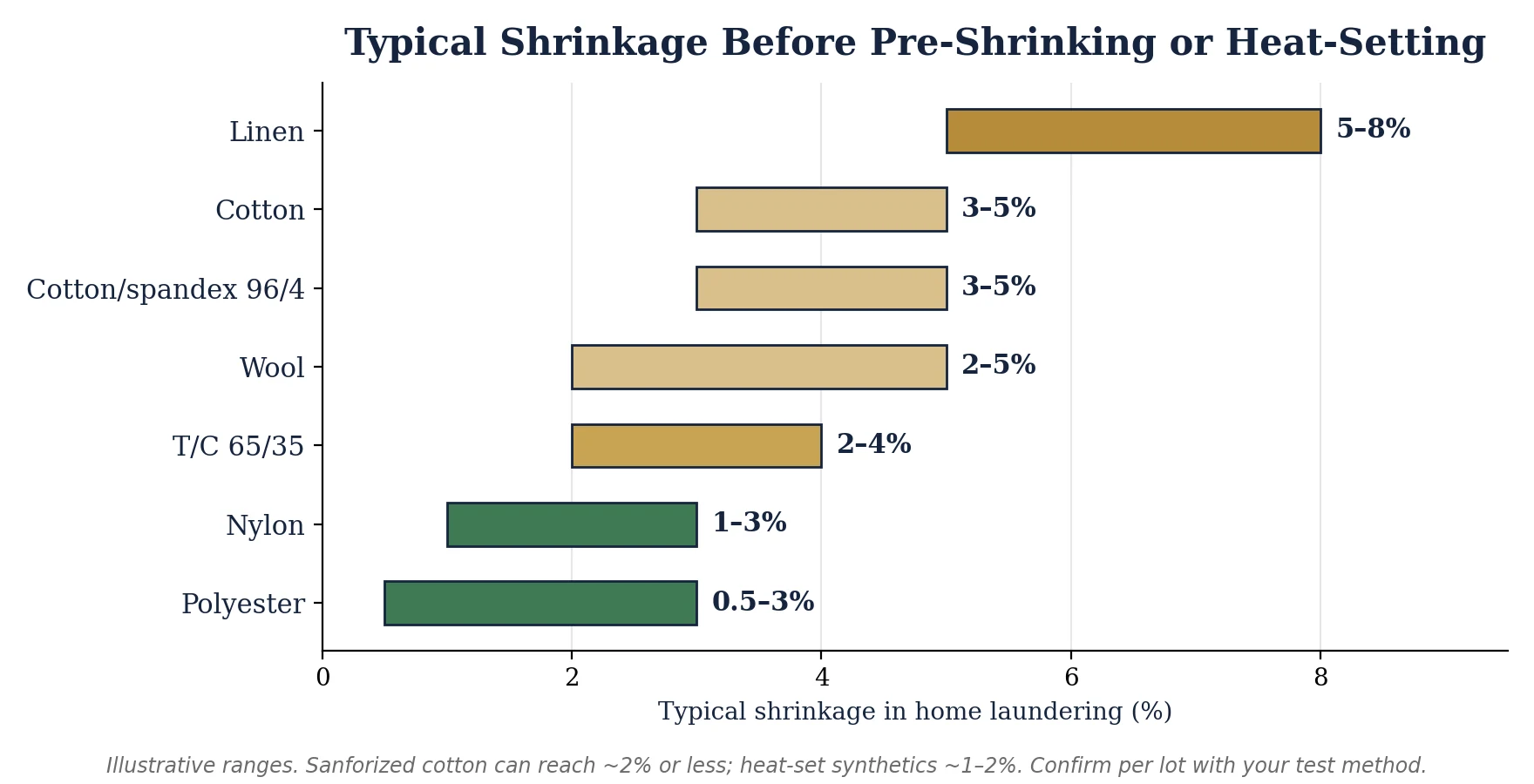
The figures below are typical ranges for fabrics in home laundering before dedicated pre-shrinking or heat-setting. Treat them as a starting point, not a specification.
Natural fibers
- Linen, 5–8%: the highest risk. Stiff, low-elasticity fibers that react strongly to water. Always pre-shrink and test before cutting.
- Cotton, 3–5%: dense poplins and twills sit at the lower end, open plain weaves at the higher end. A properly sanforized cotton can be brought to around 2% or less.
- Wool, 2–5%: besides normal shrinkage, wool can felt when washed warm with agitation. Shrink-resist treated worsteds are far more stable than untreated woollens.
Synthetics
- Polyester, 0.5–3%: the most dimensionally stable common fiber. Tight polyester wovens can shrink as little as 0.5%; open or high-stretch structures move more.
- Nylon, 1–3%: slightly more absorbent than polyester, but stable once heat-set, typically 1–2%.
- Spandex: rarely used alone. In a blend it doesn’t drive shrinkage, but excessive heat in processing or washing can damage it and distort the fabric.
Blends
A blend generally shrinks somewhere between its components, pulled toward the fiber with the larger share.
- T/C 65/35, 2–4%: the polyester share stabilizes the cotton, which is why T/C is a workwear staple.
- Cotton/spandex 95/5 or 96/4, 3–5%: behaves like cotton. The spandex adds stretch, not stability.
- Wool/polyester 50/50, 2–3%: the polyester offsets most of wool’s felting risk.
Why the same fiber can test so differently
Two cottons from different mills can be 2% and 5% apart because of density, yarn twist, how much tension the fabric was finished under, and whether it was sanforized. Fabric that is stretched during finishing to hit a width or length looks fine on the roll but relaxes back in the first wash. This is the same tension effect we explain in why fabric width isn’t always exact and why GSM shifts batch to batch.
How to specify shrinkage
- Name the test and wash conditions. For example ISO 6330 washing with ISO 5077 measurement, or AATCC 135 for US programs, at the temperature and drying method your garment will actually see.
- Set a tolerance for warp and weft separately. Many woven apparel programs work to around ±3%; uniforms and fitted garments often need tighter limits.
- Test bulk, not only the sample. Ask for a shrinkage result from the bulk lot before cutting, and adjust the pattern allowance to it if needed.
- Watch special cases: linen, untreated wool, and fabrics with spandex that may be heat-sensitive.
At Yongbo Textile we control shrinkage at the finishing stage rather than leaving it to the pattern room. Our cotton and cotton-rich fabrics such as cotton twill and cotton poplin are sanforized, synthetics are heat-set, and shrinkage is tested per lot in our ISO 17025 lab against the method and tolerance you specify. Tell us your wash conditions and target, and we will confirm the result on the bulk lot before it ships. 🌐 yongbotex.com
Frequently asked questions
How much does cotton fabric shrink?
Untreated cotton typically shrinks 3–5% in home laundering. Dense twills and poplins sit at the lower end. Properly sanforized (pre-shrunk) cotton can be brought to around 2% or less.
Does polyester shrink?
Very little. Tight polyester wovens can shrink as little as 0.5%, and most stay within 3%. Heat-setting at the mill keeps polyester dimensionally stable.
What is an acceptable shrinkage tolerance for woven fabric?
Many woven apparel programs work to around ±3% in warp and weft. Uniforms and fitted garments often need tighter limits. Agree the test method and wash conditions together with the tolerance.
How is fabric shrinkage tested?
Fabric is marked, washed and dried under a standard procedure such as ISO 6330, then re-measured following ISO 5077. US programs often use AATCC 135 for fabrics and AATCC 150 for garments.