GSM is one of the first numbers on any fabric spec sheet. It stands for grams per square meter: the weight, in grams, of one square meter of fabric. A 200 gsm twill weighs 200 grams per square meter; a 120 gsm poplin weighs 120. The higher the number, the heavier and usually the thicker the fabric.
It sounds like a fixed property, but fabric weight is the end result of choices made across weaving and finishing. Understanding what GSM tells you, and what it doesn’t, makes it much easier to compare quotes and approve bulk.
How GSM is measured
The everyday method takes a minute:
- Condition the fabric at normal room temperature and humidity for a few hours, because damp fabric weighs more.
- Cut a sample of known area. Most mills use a GSM cutter that punches a 100 cm² disc.
- Weigh the disc on a precision scale and multiply the grams by 100. A disc weighing 2.10 g means 210 gsm.
For any sample size the formula is simply GSM = weight (g) ÷ area (m²). Formal test methods are ISO 3801 and ASTM D3776, which specify sample size, number of specimens and conditioning. For bulk, many mills also weigh whole rolls and divide by area, which gives a steadier average, especially on stretch fabrics.
GSM to oz conversion
In the US and for canvas and denim, fabric weight is often given in ounces per square yard (oz/yd²).
- oz/yd² × 33.9 = gsm
- gsm ÷ 33.9 = oz/yd²
| oz/yd² | GSM (approx.) | Typical fabric |
|---|---|---|
| 3 oz | 100 gsm | Light shirting, linings |
| 4 oz | 135 gsm | Poplin shirts |
| 6 oz | 205 gsm | Chinos, light workwear |
| 8 oz | 270 gsm | Work trousers, heavy twill |
| 10 oz | 340 gsm | Canvas for bags and aprons |
| 12 oz | 405 gsm | Heavy duck canvas |
Watch out for ounces per linear yard, which some US suppliers still quote. That figure depends on the fabric width as well as its weight, so always confirm which one is meant.
Typical GSM by fabric type and end use
GSM should follow the product. These are the ranges we weave most often:
| Fabric | Typical GSM | Common uses |
|---|---|---|
| Polyester taffeta | 50–90 | Linings, light jackets, down shells |
| Polyester pongee / nylon ripstop | 60–120 | Windbreakers, outdoor shells, bags |
| T/C shirting poplin / cotton poplin | 90–160 | Uniform shirts, blouses |
| Cotton sateen | 130–220 | Chinos, dresses |
| CVC | 130–260 | Shirts, uniforms, workwear |
| Cotton twill | 180–320 | Chinos, cargo pants, jackets |
| T/C workwear twill | 200–320 | Industrial uniforms, coveralls |
| Cotton canvas | 220–450 | Bags, aprons, heavy workwear |
A higher GSM is not automatically better. It means more fiber, which usually adds durability, warmth and opacity, but also cost and stiffness. Yarn quality, construction and finishing decide performance just as much; see how finishing can weaken fabric strength even at the same weight.
Why GSM changes from batch to batch
Yarn count and density set the starting point, and finishing fine-tunes the result:
- Shrinkage steps add weight. Dyeing, washing and pre-shrinking make the fabric contract, packing more yarn into each square meter.
- Stenter tension removes weight. Stretching the fabric wider or longer on the stenter spreads the same yarn over more area.
- Chemical finishes nudge it. Softening, enzyme or alkali treatments can make yarns slightly finer.
None of these are mistakes. They are the normal levers a mill uses to hit target weight while also controlling width, hand and shrinkage at the same time.
What tolerance to expect
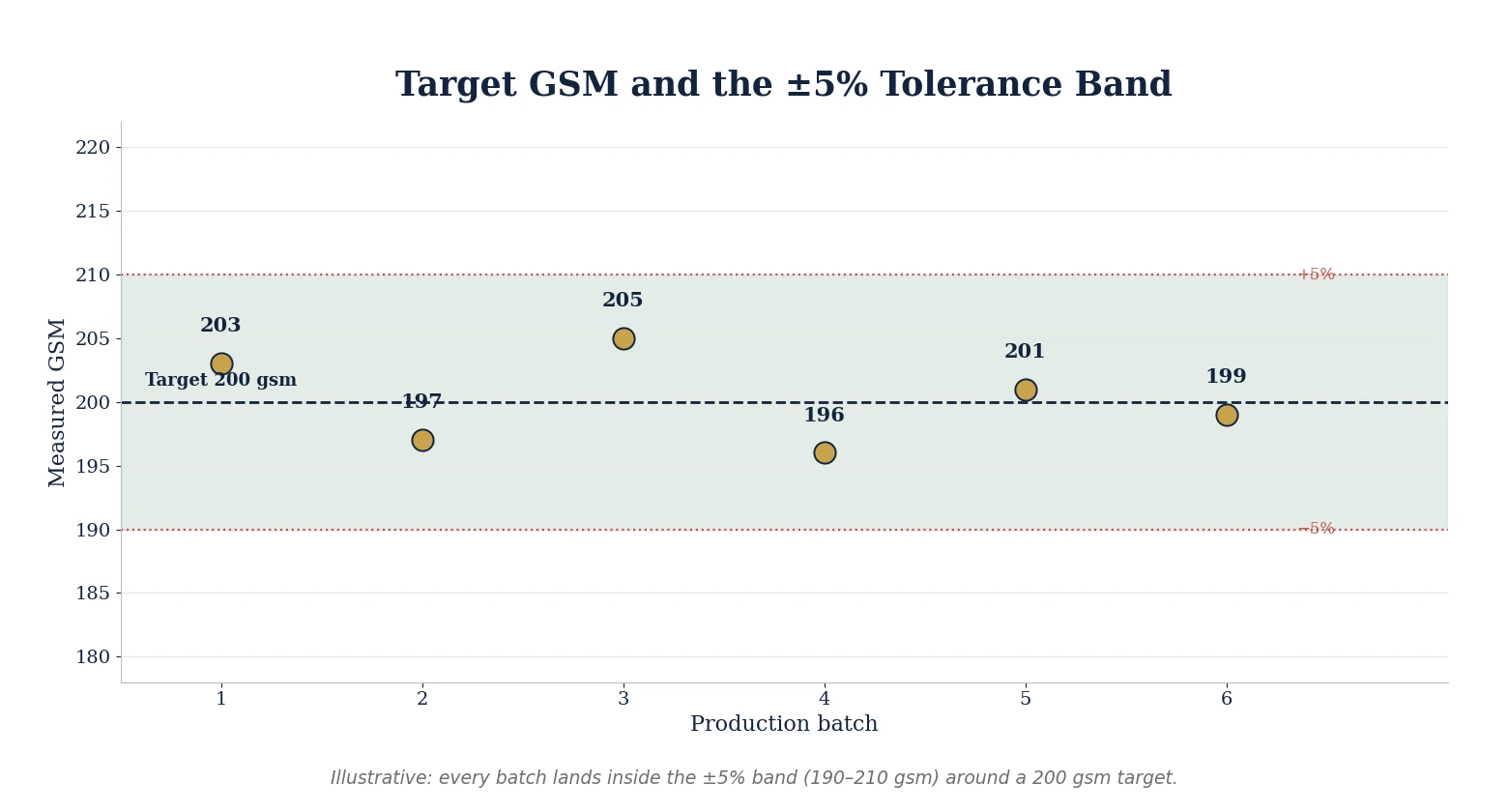
For most woven fabrics, ±5% around the target GSM is a fair and commonly accepted range. On a 200 gsm fabric that means 190–210 gsm. If your product is weight-sensitive, such as technical outerwear or a program priced per kilogram, write the tolerance and test method on the PO and ask whether the mill checks weight roll by roll on larger orders.
How to specify GSM on your order
- State the finished GSM, not the greige weight, and the tolerance (for example 260 gsm ±5%).
- Say whether it is measured before or after washing, especially for cotton.
- If you think in ounces, give oz/yd² and let the mill confirm the GSM equivalent.
- Approve weight on a bulk-representative sample, not only on a hand-loom swatch.
At Yongbo Textile, weight is checked during finishing, not just at final inspection: the first roll off the stenter is weighed before the rest of the batch runs, and settings are adjusted if needed. Tell us your target GSM and end use, or send a sample, and we’ll match the construction to it. 🌐 yongbotex.com
Frequently asked questions
What does GSM mean in fabric?
GSM means grams per square meter. It is the weight of one square meter of fabric and the most common way to describe how light or heavy a fabric is.
How do you calculate fabric GSM?
Cut a sample of known area, usually a 100 cm² disc with a GSM cutter, weigh it on a precision scale and multiply the grams by 100. For a sample of any size, GSM = weight in grams ÷ area in square meters.
How do I convert GSM to oz?
Divide GSM by 33.9 to get ounces per square yard, or multiply oz/yd² by 33.9 to get GSM. For example, 200 gsm is about 5.9 oz/yd². Note that some US mills quote ounces per linear yard, which also depends on width.
What GSM is good for work trousers?
Most work trousers and cargo pants use 220–320 gsm twill or ripstop. Lighter 180–220 gsm suits summer and casual trousers; heavier weights add durability for hard-wearing workwear.
Is a higher GSM always better quality?
No. GSM describes weight, not quality. A light fabric with fine, strong yarns can outperform a heavier one. Choose GSM for the end use, then check strength, shrinkage and colorfastness separately.
What GSM tolerance is acceptable?
For most woven fabrics, about ±5% of the target GSM is a commonly accepted tolerance. Weight-sensitive programs should state their tolerance and test method on the purchase order.