If you’ve ever received a shipment where the fabric measured 143 cm instead of the 145 cm on the spec sheet, you’ve run into one of the most common — and most misunderstood — variables in woven fabric: width isn’t fixed by the loom alone. It moves through every stage of dyeing and finishing, and a good mill manages that movement instead of pretending it doesn’t happen.
Why width shifts in the first place
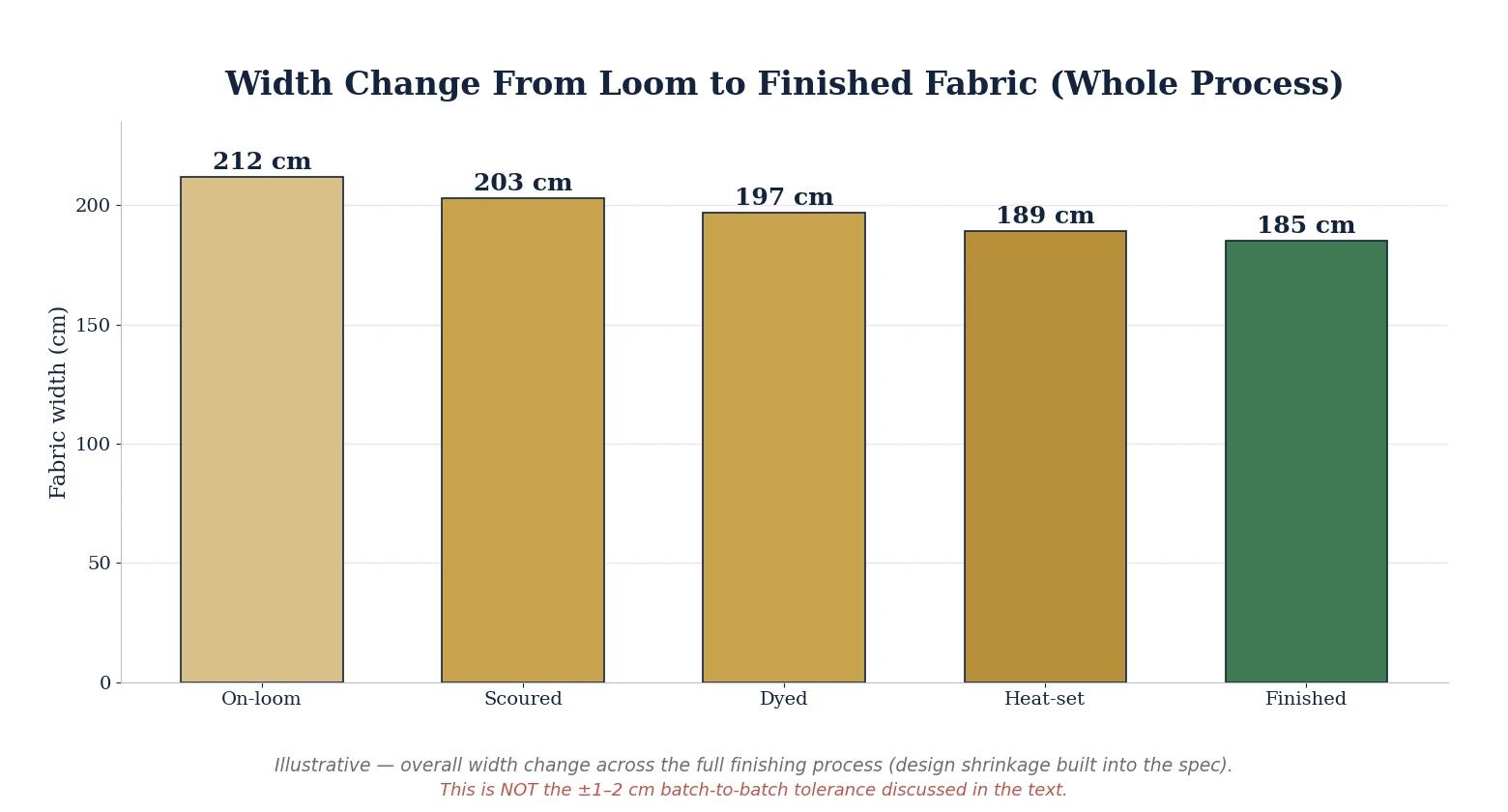
Width starts with how the fabric is woven, but it doesn’t stay put. Scouring, pre-shrinking, dyeing and heat-setting all pull or relax the fabric to different degrees, and each stage can add or subtract a few centimeters. Stretch fabrics move more than plain ones — a fabric that goes onto the finishing line at 210 cm can easily come off at 180 cm once the elastane relaxes into its finished state. Even the tension settings on the stenter (the machine that sets final width and grain) shift width directly: pull it tighter and the fabric gets narrower but flatter; ease it and width increases but the surface may not sit as smooth.
What that means for your cutting plan
None of this is a defect — it’s physics. But it does mean the width on your spec sheet should be read as a target with a tolerance, not a guaranteed exact number. For most woven fabrics, ±1–2 cm is a reasonable expectation; stretch and heavily textured fabrics can run a little wider. If your garment pattern is tight against the fabric width (common with wide panels or minimal-waste marker layouts), that tolerance matters — it’s worth building a small buffer into your cutting yield calculations rather than assuming every roll lands exactly on spec.
What to ask your supplier
A mill that controls width well can tell you, without hesitating: what tolerance to expect for your specific construction, and whether they measure width roll-by-roll or only sample-check per batch (roll-by-roll is worth asking for, especially on large orders). It’s also fair to ask whether your fabric will be measured with or without the selvedge included — this small detail changes the usable width you’re actually cutting from.
At Yongbo Textile, width control runs through every stage of our in-house dyeing and finishing — from pre-shrinking to final stenter setting — so what we quote is what you can plan your marker around. 🌐 yongbotex.com