A garment can pass every strength test and still disappoint the end customer within weeks, because small balls of fiber have gathered on the cuffs, the seat or the inner thighs. Pilling rarely makes a fabric unusable, but it makes it look worn, and it drives a large share of consumer complaints. For buyers the question is not whether a fabric can pill, but how much, under which test, and what grade to put in the contract.
Why fabrics pill
Pilling happens in two stages. Friction first pulls loose fiber ends to the surface as fuzz, then the fuzz tangles into small balls that stay anchored to the fabric. Whether those balls build up depends on four things:
- Fiber. Short staple fibers pill more than continuous filament. Strong synthetic fibers such as polyester and nylon are the trickiest: their pills don’t break off, so they accumulate. That is why a spun polyester or a T/C blend often pills more visibly than 100% cotton.
- Yarn. Loosely twisted yarns release fiber ends easily. Higher twist and compact or ring-spun yarns hold fibers in place.
- Construction. Tight wovens pill less than open weaves and far less than most knits. Within wovens, brushed, peached and napped surfaces are designed to have fuzz and behave differently.
- Finishing. Singeing, enzyme bio-polishing on cotton, heat-setting on synthetics and anti-pilling finishes all reduce the loose surface fibers that start the process.
The main test methods
All methods do the same thing: rub the fabric in a controlled way, then compare it with reference photographs under standard lighting. They differ in how the rubbing is done, so a grade is only meaningful together with its method and cycle count.
- Modified Martindale (ISO 12945-2, ASTM D4970). The fabric is rubbed against itself or a wool abradant in a figure-of-eight path, with the result assessed at set cycle counts. It is the most widely used method for woven apparel and home textiles in Europe and is our default for wovens.
- Pilling box (ISO 12945-1). Specimens mounted on tubes tumble inside a cork-lined box. Common for knitwear such as sweaters, less so for wovens.
- Random tumble (ASTM D3512). Specimens tumble freely in a chamber with cork liners. Frequently used in US programs.
- Circular locus (GB/T 4802.1). A brush-and-abradant method widely used in China for routine checks, with relatively short test times.
If your buyer or lab works to a specific method, state it. Results from two methods cannot be compared directly.
Reading the grades
Pilling is graded from 5 to 1, often in half grades:
- 5: no change
- 4: slight fuzzing or slight pilling
- 3: moderate fuzzing or pilling, partly covering the surface
- 2: distinct fuzzing or pilling, covering a large part of the surface
- 1: dense fuzzing or pilling over the whole surface
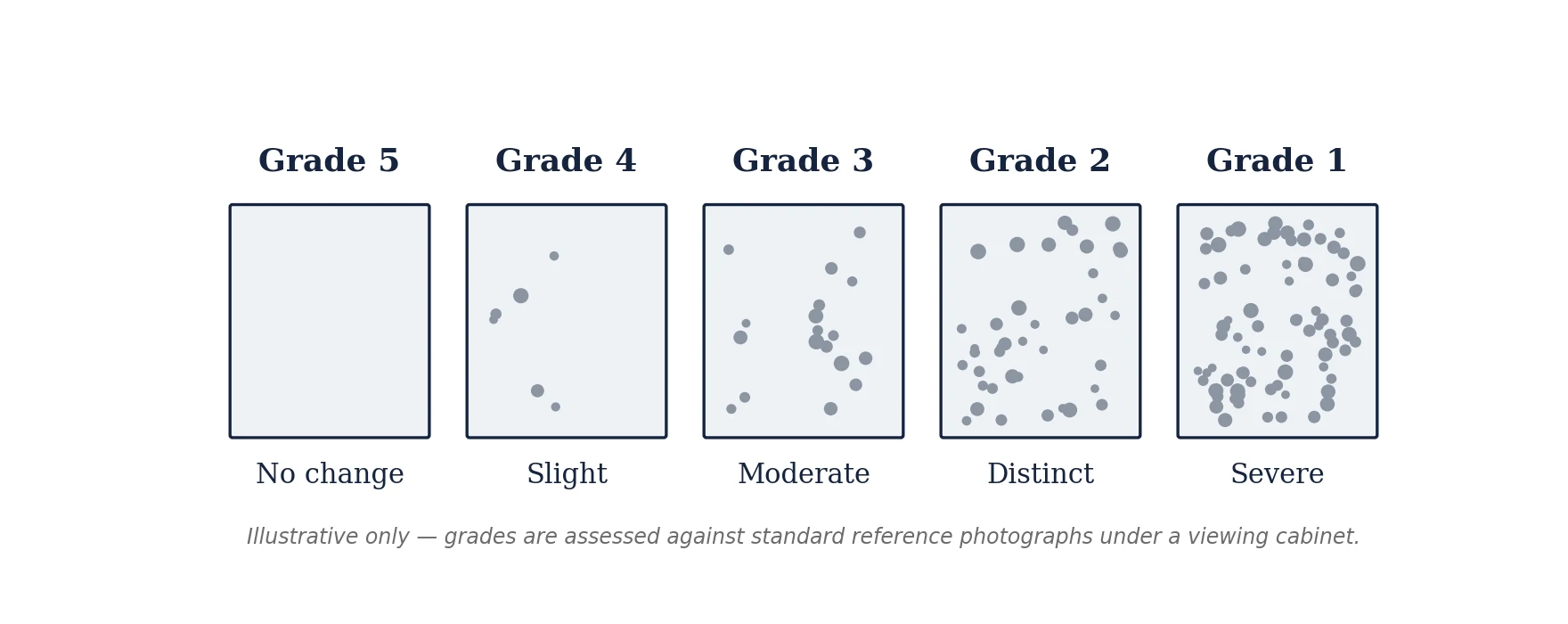
Many apparel programs ask for grade 3–4 or better on wovens, with stricter targets for uniforms and workwear that are worn and laundered hard. The right target depends on the end use and the cycle count, so agree both together.
How to specify pilling on a purchase order
- Name the method and the cycles, for example “ISO 12945-2, grade ≥ 3–4 at the agreed cycle count”, not just “anti-pilling”.
- Mark the face side of the sample you approve, since the back of a fabric can test differently.
- Send enough fabric for the method your lab uses, so the test doesn’t have to be repeated.
- Flag special surfaces. Brushed, peached or napped fabrics are designed with surface fiber; agree in advance how, or whether, they will be assessed.
- Test each fabric separately in garments that combine several fabrics, such as panelled, reversible or detachable styles.
At Yongbo Textile, pilling is decided long before the test lab. We choose yarn twist and construction with the end use in mind, and apply singeing, bio-polishing on cotton, heat-setting on synthetics or an anti-pilling finish where the program needs it. Tell us your target grade and test method and we will build the fabric to it, from T/C workwear twill and CVC to polyester twill. Pilling is one of the baseline checks we run alongside colorfastness and GSM tolerance. 🌐 yongbotex.com
Frequently asked questions
What is a good pilling grade for woven fabric?
Grade 3–4 or better is a common target for woven apparel, with stricter targets for uniforms and workwear. Always state the test method and the number of rubbing cycles with the grade.
Which pilling test is used for woven fabrics?
The modified Martindale method (ISO 12945-2, or ASTM D4970 in the US) is the most widely used for woven fabrics. The pilling box (ISO 12945-1) is mainly used for knitwear, and random tumble (ASTM D3512) is common in US programs.
Why does polyester pill more than cotton?
Polyester fibers are very strong, so once a pill forms it stays anchored instead of breaking off. Cotton pills tend to wear away, so they are less visible over time.
How can a mill reduce pilling?
By using higher-twist or compact yarns, tighter constructions, and finishing such as singeing, enzyme bio-polishing for cotton, heat-setting for synthetics, or an anti-pilling finish.