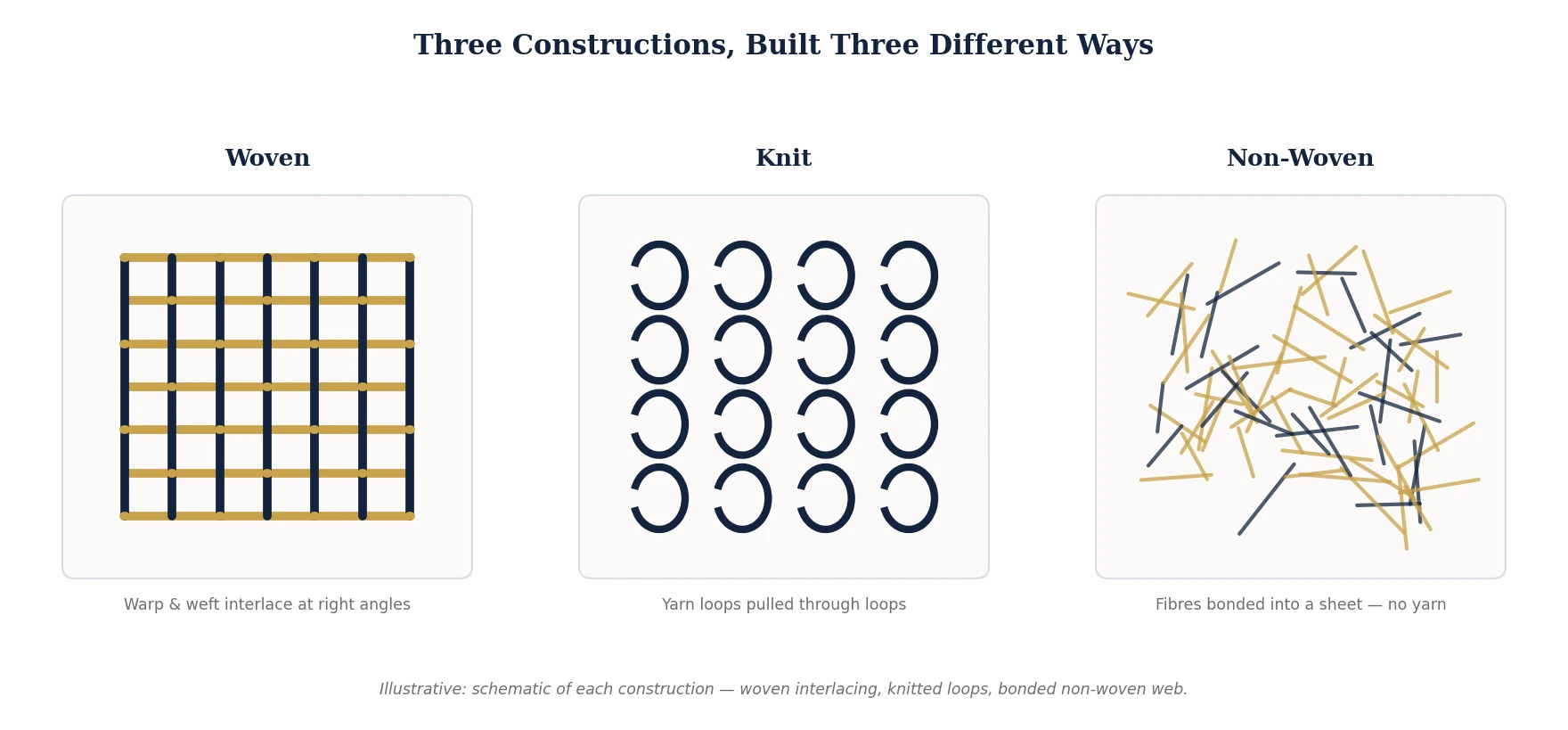
“Fabric” covers three fundamentally different materials. Woven fabric is built from two yarn systems interlacing at right angles; knit fabric is built from loops of yarn pulled through loops; non-wovens skip yarn altogether and bond fibers directly into a sheet. This isn’t textbook trivia — the construction decides how a fabric stretches, drapes, wears and washes, and it also decides which kind of mill can actually make it for you.
Woven: structure and stability
Because warp and weft cross at right angles and lock each other in place, woven fabric is dimensionally stable, holds a crease, resists stretching out of shape, and takes structured tailoring — which is why shirts, trousers, workwear, uniforms and outerwear are overwhelmingly woven.
Nearly every woven fabric is built on one of three foundation weaves (see plain vs twill vs satin for the full explanation). Plain weave — one over, one under — has the most interlacing points, giving a firm, tight, matte surface (poplin and most shirting live here). Twill interlaces less often, creating the familiar diagonal line; fewer interlacings mean a softer, thicker, more abrasion-tolerant cloth, which is why workwear staples like drill, chino and denim are twills. Satin floats yarns long across the surface for smoothness and luster at some cost to snag resistance. From these three, mills derive countless variations — herringbone, dobby textures, ripstop grids — but the drape-stability-durability logic always traces back to how often the yarns interlace.
Knit: stretch and comfort
A knit is a chain of loops, and loops can deform — that’s where a knit’s stretch and recovery come from, no elastane required. Weft knits (T-shirts, polos, fleece) stretch generously in width; warp knits (sportswear, linings, lace) are more stable and resist running. Knits excel where comfort and movement rule, but they’re harder to tailor sharply and less dimensionally stable than wovens — a knit uniform trouser would bag at the knees within a week.
Non-woven: engineered sheets
Non-wovens bond fibers directly — by needle-punching, water-jet entangling, thermal bonding or adhesives — with no yarn stage at all. That makes them fast and cheap to produce and easy to engineer for a function (filtration, insulation, disposability), which is why they dominate interlinings, medical disposables, geotextiles and shopping bags. They generally trade away the durability and launderability of woven or knit cloth, so they support garments more often than they become them.
Why this matters when you source
Two practical takeaways. First, construction determines the right supplier: weaving, knitting and non-woven production run on entirely different machinery, and a mill that excels at one rarely runs the others in-house — so a “one factory does everything” claim deserves a careful look at what’s actually made on-site versus traded. Second, a ten-second check saves confusion: stretch the fabric on the bias and along its width — significant natural stretch with loop texture on the back says knit; firm resistance with visible crossing yarns says woven; a felt-like sheet with no yarn structure at all says non-woven.
Yongbo Textile is a woven-fabric specialist — weaving, dyeing and finishing under one roof in Jiaxing, focused on the shirting, workwear and uniform fabrics where woven construction is the right answer. 🌐 yongbotex.com
Frequently asked questions
What is the difference between woven and knit fabric?
Woven fabric is made by interlacing two sets of yarns at right angles on a loom, which makes it stable with little natural stretch. Knit fabric is made by pulling loops of yarn through each other, which gives it natural stretch and recovery.
Is woven or knit fabric more durable?
For tailored garments, workwear and uniforms, woven fabric is usually more durable and keeps its shape better. Knits are more comfortable and flexible but can bag out and snag more easily.
Does woven fabric stretch?
Plain woven fabric has very little stretch, mainly on the bias. Stretch wovens get their give from spandex in the yarn, for example cotton-spandex or 4-way stretch polyester.
Which fabric is better for summer, woven or knit?
Both can be. Lightweight woven cotton or linen is crisp and airy; lightweight cotton jersey knit is soft and stretchy. Fiber and weight matter more than construction.
What is non-woven fabric?
A fabric made by bonding fibers directly, mechanically, thermally or chemically, without spinning them into yarn. It is used for interlinings, filters, medical disposables and shopping bags.