Pick up a pair of jeans, chinos or work trousers and look closely at the surface: you’ll see fine diagonal lines running across it. That is twill. It is one of the three basic weaves behind almost every woven fabric, and understanding the three helps you choose the right fabric and talk to a mill in its own language.
The three basic weaves
Every woven fabric is made by interlacing two sets of yarns at right angles: the warp (lengthwise) and the weft (crosswise). How often they cross decides almost everything about the fabric. Textile engineers call plain, twill and satin the three foundation weaves; dobby, jacquard, herringbone and ripstop are all variations or combinations of them.
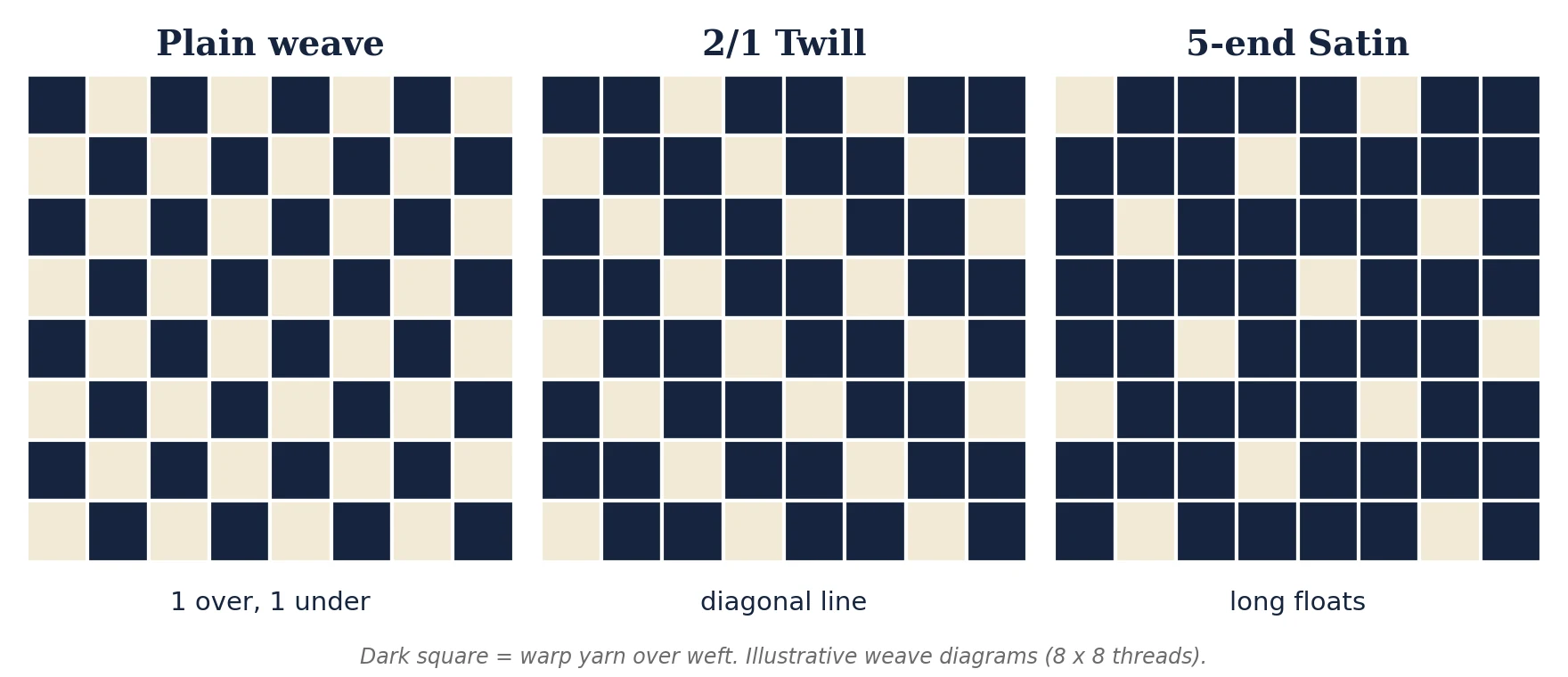
Plain weave: one over, one under
Each weft yarn passes over one warp yarn and under the next, alternating on every row. That gives the most interlacing points of any weave.
- Firm, flat and stable, with the same look on both sides
- Good abrasion and snag resistance, since there are no long floats
- Usually the lightest construction at a given yarn count, with a crisper hand and less luster
- Cannot be packed as densely as other weaves
Typical plain-weave fabrics: cotton poplin and shirting, canvas, polyester taffeta and pongee. Ripstop is a plain weave with a reinforcing grid added.
Twill: the diagonal line
In a twill, each yarn floats over two or more yarns, and the interlacing point steps along by one thread on every row. Those stepped points line up into the diagonal rib. A twill running from lower left to upper right is a right-hand twill; the opposite is a left-hand twill.
- Fewer interlacing points than plain weave, so yarns can be packed denser, making a thicker, heavier cloth
- Softer hand, better drape, better wrinkle recovery and a little more luster than plain weave
- Face and back look different
- The diagonal texture hides soiling well, which matters for workwear
Twill is described by its float, such as 2/1 (over two, under one) or 3/1 (over three, under one). Typical twill fabrics: cotton twill, drill and chino, denim, gabardine, and T/C workwear twill.
Satin: long floats, high luster
In satin (sateen when made from cotton), each yarn floats over four or more yarns before interlacing, and the interlacing points are scattered so they never form a line.
- The smoothest, most lustrous surface, with a soft hand and fluid drape
- Can be woven to the highest density of the three
- Long floats snag and abrade more easily, so satin is less hard-wearing
Typical satin fabrics: cotton sateen for chinos and premium bottoms, and satin linings.
Side-by-side comparison
| Property | Plain | Twill | Satin |
|---|---|---|---|
| Interlacing points | Most | Medium | Fewest |
| Firmness and snag resistance | Highest | Medium | Lowest |
| Possible density | Lowest | Medium | Highest |
| Softness and drape | Crisp | Soft | Softest |
| Luster | Matte | Medium | Highest |
| Face vs back | Same | Different | Different |
Which weave fits your product?
- Shirts and blouses: plain weave (poplin) for a crisp, clean surface.
- Workwear, cargo pants, chinos: twill. Its density and weight give durability, and the diagonal hides wear and dirt.
- Premium trousers and dresses: satin or sateen for sheen and drape, accepting more care in use.
- Outdoor shells and bags: plain weave or ripstop for a tight, flat base that takes coating well.
When you request a quote, name the weave along with fiber, weight and width, for example “100% cotton 3/1 twill, 260 gsm, 57/58 inches”. It removes guesswork and keeps samples consistent.
At Yongbo Textile we weave plain, twill and satin constructions in cotton, T/C, CVC, polyester and nylon, and finish them in-house to your spec. Not sure which construction suits your product? Send us the end use and we’ll recommend one and send swatches. 🌐 yongbotex.com
Frequently asked questions
What is twill fabric?
Twill is a woven fabric in which each weft yarn passes over two or more warp yarns, with the interlacing point shifting by one thread on each row. This creates the diagonal ribs typical of denim, chino, drill and gabardine.
What is the difference between twill and plain weave?
Plain weave interlaces one over, one under, giving the most interlacing points: a flat, firm, lighter fabric. Twill interlaces less often, so it can be packed denser, drapes better, hides soiling and wrinkles better, and is usually heavier and softer.
Is twill stronger than plain weave?
At the same yarn and density, plain weave is the firmer structure. In practice twills are often woven much denser and heavier, which is why heavy cotton and T/C twills are the standard for durable workwear.
What does 2/1 or 3/1 twill mean?
It describes the float: in a 2/1 twill each warp passes over two weft yarns and under one; in a 3/1 twill over three and under one. Higher floats give a bolder diagonal and a heavier, softer fabric.
Is twill good for summer or winter?
Twill is made in every weight. Light cotton twills around 180 gsm are comfortable in warm weather; heavy twills of 250–320 gsm are used for workwear and cooler seasons.