Two stretch fabrics can feel almost identical on the roll and behave completely differently after a few washes — one keeps its shape, the other bags out at the knees or waist. The difference usually isn’t the spandex brand on the label. It’s a handful of construction and finishing decisions that don’t show up until the fabric has been worn and washed.
It starts with the spandex itself
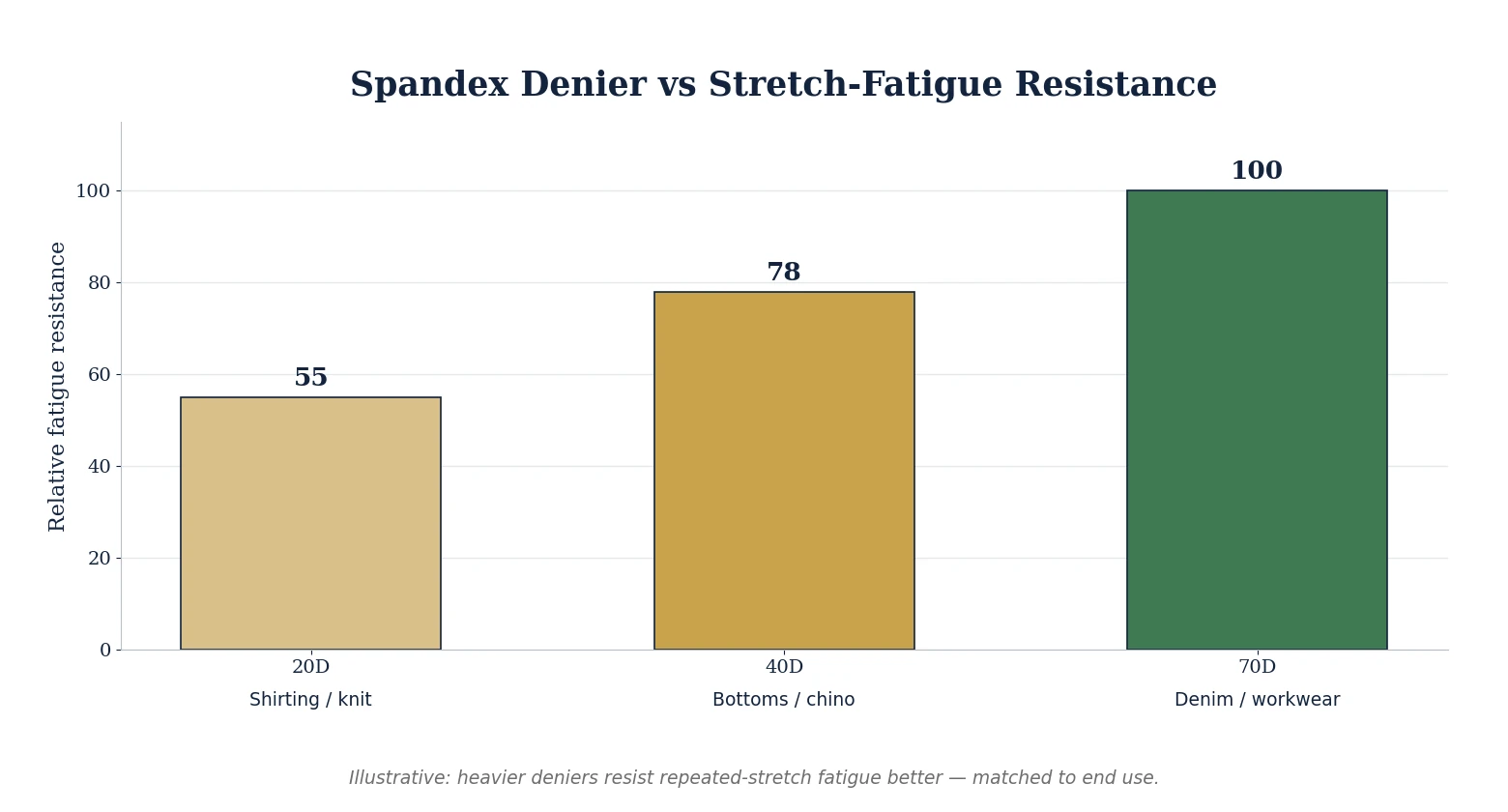
Most stretch woven fabric gets its elasticity from spandex (elastane) blended into the yarn, most commonly in three deniers — roughly light (20D), medium (40D) and heavy (70D). Heavier spandex resists fatigue better over repeated stretching, which is why it shows up more in fabrics that take a beating, like denim and workwear, while lighter spandex is common in shirting and knitwear where the stretch demand is gentler. Spandex content is usually in the low single digits by weight — often around 2–5% — but the real number depends on the denier used and how much the yarn is drawn (stretched) during processing: draw it too much and you lose stretch efficiency; draw it too little and recovery suffers.
Where finishing can quietly ruin good stretch
Even fabric built with quality spandex can lose performance in processing. Getting the sequence wrong — for example, pre-shrinking before the fabric has been properly relaxed — can leave the surface uneven. Chasing a flatter, more even surface by pushing finishing temperature higher is one of the most common ways spandex gets weakened, because elastane doesn’t tolerate high heat as well as the base fiber does. And harsh reducing or bleaching chemistry used in some dyeing steps can degrade spandex further if not carefully controlled. None of this shows up on a spec sheet — it only shows up as poor recovery after the fabric has been through a few wash cycles.
What to check before you commit to bulk
Stretch percentage on a swatch tells you how far the fabric stretches — it doesn’t tell you whether it recovers cleanly. Before committing to bulk, it’s worth asking your supplier for a wash-test result specifically on recovery (does the fabric return close to its original dimension after repeated home laundering, not just a single stretch-and-release test), and confirming the spandex denier used for your construction. A mill that’s controlling this properly will have that data ready, not just a stretch percentage on the tech pack.
At Yongbo Textile, our stretch fabrics are finished in-house with tension and temperature tuned specifically to protect spandex recovery — because a stretch fabric that sags after wash isn’t really a stretch fabric. 🌐 yongbotex.com