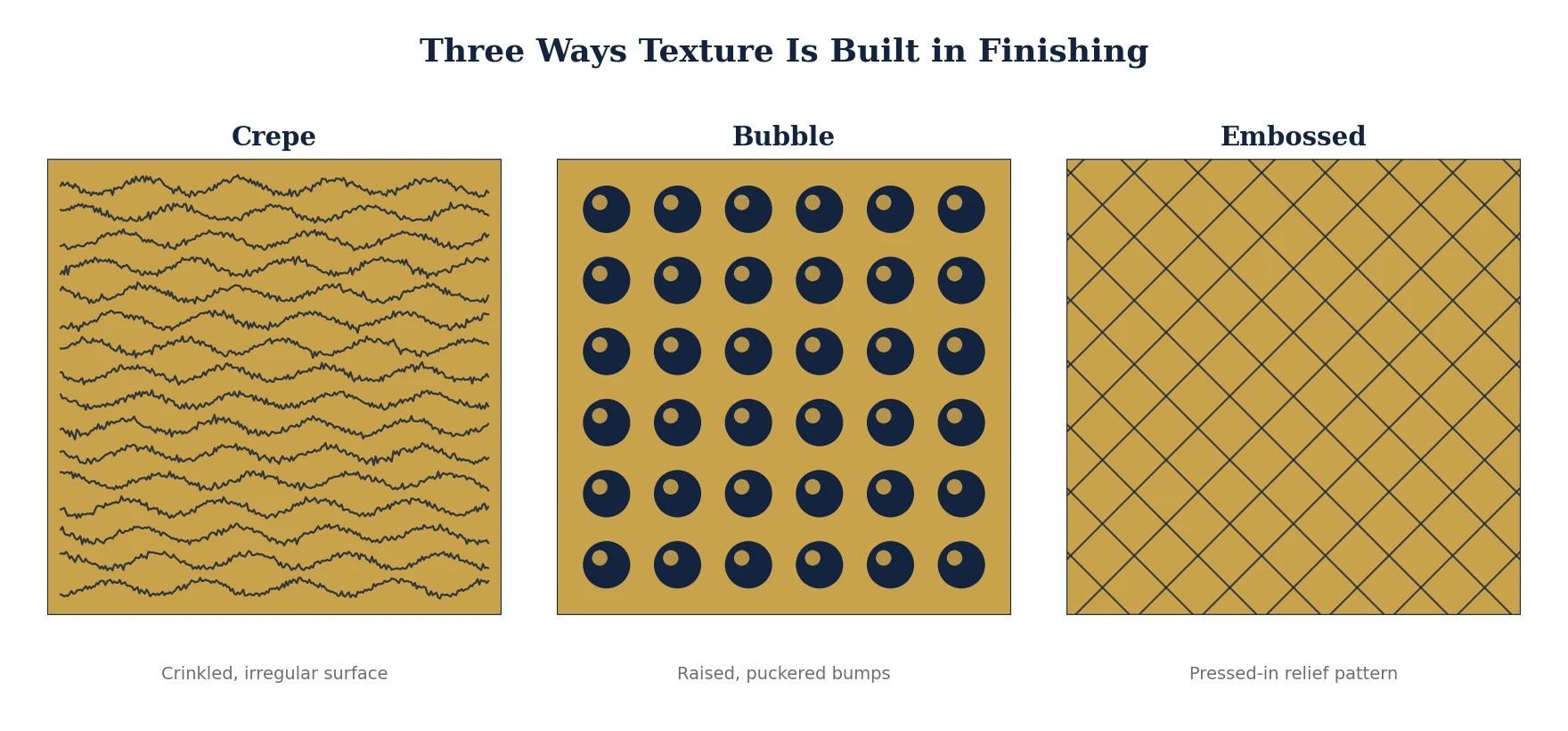
Some of the most distinctive fabric surfaces you’ll see on a hangtag — crinkled crepe, puckered bubble texture, a raised embossed pattern — aren’t created by the weave alone. They’re built (or exaggerated) through specific finishing techniques, and each comes with its own production considerations worth knowing before you spec it into a program.
Crepe texture
Crepe’s crinkled, slightly irregular surface usually comes from an intentional imbalance between how much the warp and weft yarns are allowed to shrink during finishing. By controlling tension differently in each direction — often letting the crosswise yarns pull in more than the lengthwise ones — finishers create the fine, random-looking ridges that define crepe. Because the effect relies on careful, deliberate imbalance rather than uniform processing, crepe fabric usually requires closer process control (and sometimes tighter tolerances) than a flat, evenly finished fabric.
Bubble / puckered texture
Bubble texture — small raised bumps or a puckered surface, sometimes seen on cotton-poly blends — can come from the weave structure itself, or be created chemically. One common chemical method uses a caustic treatment applied in a pattern, which shrinks only the treated areas and leaves the rest of the fabric flat, creating a 3D puckered effect from an otherwise plain fabric. Because the pattern is set chemically, bubble texture typically needs a dedicated production run and isn’t something that can be added as a last-minute finishing step on standard yardage.
Embossed texture
Embossing uses heat and pressure — passed through an engraved roller — to press a permanent pattern or shine into the fabric surface, most effective on fabrics with heat-sensitive synthetic content. The depth, gloss and how “permanent” the pattern feels depends on temperature, pressure and how many passes the fabric makes through the embossing rollers. It’s a relatively fast finishing step, but the die/roller itself needs to be sourced or custom-made for your specific pattern, which is the main lead-time factor to plan around.
What to plan for when sourcing textured fabric
All three of these are fundamentally different from ordering a standard flat fabric: they usually require a dedicated finishing run (not a quick add-on), the texture needs to be approved on an actual finished swatch rather than judged from a flat greige sample, and lead times typically run longer to account for the extra process step or custom tooling. If a textured fabric is central to your design, it’s worth flagging it to your supplier at the specification stage, not after bulk placement.
At Yongbo Textile, our finishing line runs both standard flat finishing and specialty texture treatments in-house — so unusual requests don’t mean losing control over quality or timeline. 🌐 yongbotex.com