Anyone who has sourced fabric knows the pain. The sample looks perfect, then the bulk arrives with shade variation and defects. A promised lead time slips, and your production line sits idle through peak season. One batch feels different from the next, and it shows in the finished garment.
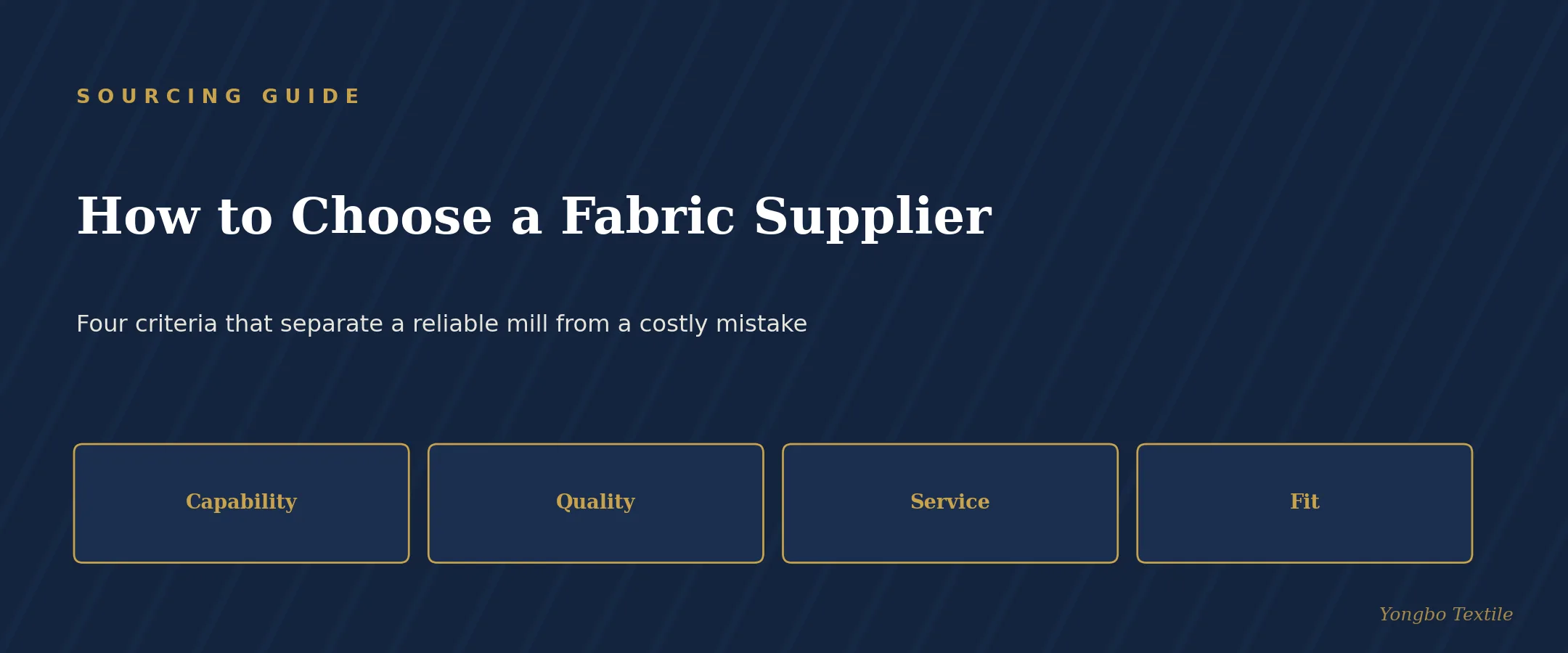
Choosing the right fabric supplier is half the battle won. And the decision is not really about who sends the lowest quote or the nicest swatch — it’s about a few hard criteria that determine whether quality stays stable and delivery stays reliable. Here are the four that matter, and how to verify them.
1. Capability — can they actually make it, consistently?
Start with what kind of operation you’re dealing with.
A real mill, not a chain of middlemen. Favor a source mill that controls its own production — from greige weaving through dyeing, finishing and printing — over a trader who buys anonymous stock and resells it. The more hands between the loom and your order, the less control anyone has over quality. A vertically integrated mill owns the whole chain, and owns the outcome.
Capacity and supply-chain depth. Work out how much fabric you need per month, then check the supplier can actually absorb it without cutting corners. A mill running far over capacity will compress process time or quietly outsource — and quality suffers. Ask about their raw-material sourcing too: a supplier with several yarn and dye sources, and some buffer stock, can absorb market shocks; one dependent on a single source cannot.
2. Quality — does the bulk match the sample, every time?
This is where most sourcing goes wrong. Buyers obsess over the sample — fastness, shrinkage, weight all pass — and sign. Then comes “sample perfect, bulk disaster.”
Batch-to-batch consistency matters more than a single good sample. Don’t just read one test report. Ask for batch test data on the same fabric over the last three months and compare the figures. If the numbers barely move across batches, their process control is real.
Look at the QC process, not just the certificate. A reliable supplier inspects before (raw materials), during (in-process checks on weaving and dyeing) and after (representative sampling of every bulk batch — not just the best roll). Because we dye and finish in-house, our recipes are traceable and repeatable, which is exactly what keeps reorder colors matching months later.
Agree the defect tolerance up front. Define the acceptable defect standard (broken ends, slubs, shade variation per meter) and how non-conforming goods are handled — replacement, re-supply, or compensation. Settling this before production prevents finger-pointing later.
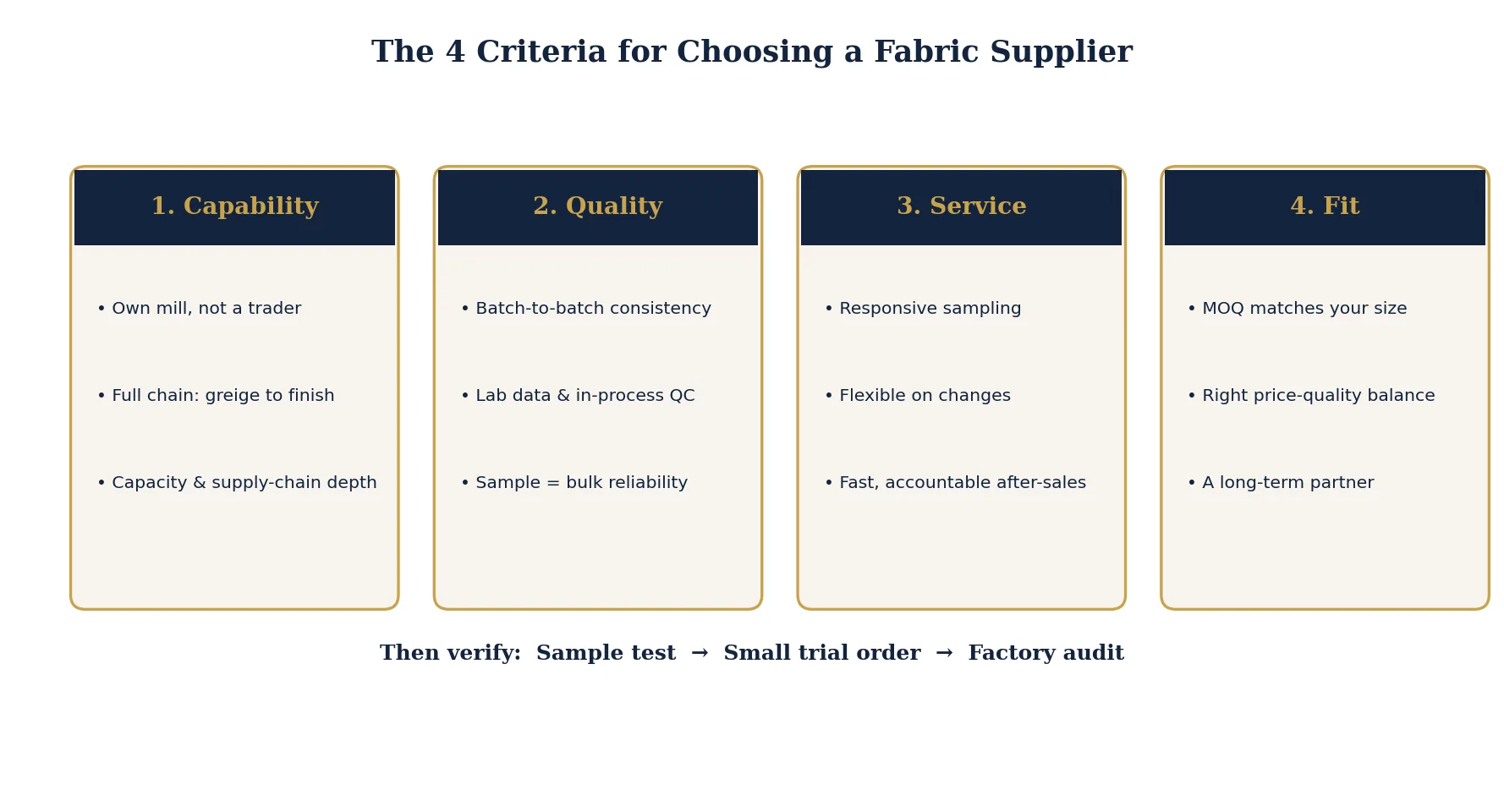
3. Service — will they support you through the whole cycle?
Fabric sourcing is never a one-off transaction. It runs from sampling, through mid-production changes, to after-sales.
Sampling. New development means adjusting color, weight and hand repeatedly. A good supplier has a dedicated sampling team that grasps your spec quickly, turns samples around on time, and offers professional suggestions. A supplier who is slow to sample, careless with revisions, or refuses small-batch sampling will be a headache later.
Flexibility mid-production. Designs change; quantities get adjusted. A good mill accommodates reasonable changes instead of refusing or raising prices on the spot. If a minor issue appears — slight shade variation, small width deviation — they help solve it (optimizing cutting layout, re-supplying) rather than walking away.
After-sales. Even with careful vetting, bulk can occasionally have issues. What matters then is response: a reliable supplier replies within 24 hours and proposes a solution within 48 — re-inspection, replacement, or taking responsibility — instead of stalling or going silent.
4. Fit — are they the right match for you?
The “best” supplier on paper isn’t always the best for you.
MOQ that matches your size. If your volume is modest, a giant supplier may not prioritize you — a focused mill that welcomes your order size will serve you better. (This is where flexible MOQ matters: small-batch and digital-print runs let growing brands start without huge commitments.)
The right price-quality balance. The cheapest fabric usually carries hidden costs — rework, delays, inconsistency — that cost more than they save. Judge total value, not headline price.
A long-term partner. Choosing a supplier is choosing a relationship, not just buying goods. The right one grows with you.
How to verify before you commit
Criteria are only useful if you check them. A practical sequence:
- Sample test — request swatches or paid cuttings; test hand-feel, shade and key indicators against your spec.
- Small trial order — before any large commitment, place a small order to verify lead time, bulk quality and responsiveness in real conditions.
- Factory audit — for larger or long-term programs, visit (or send a third party) to confirm the operation matches what was promised: equipment, in-line QC, warehouse stock.
And always sign a clear contract covering quality standard, lead time, price, liability and after-sales terms. A good contract protects both sides.
At Yongbo Textile, we built our business around exactly these criteria: a vertically integrated mill with in-house dyeing, traceable quality, flexible MOQs for growing brands, and an open door for factory audits. If you’re evaluating fabric suppliers, we’d welcome the comparison. 🌐 yongbotex.com