A fabric quoted as T/C 65/35 costs meaningfully more than 80/20 polyester-cotton — and on a bulk order, that composition gap is real money. Yet fiber content is invisible to the eye: two swatches can look and feel nearly identical while containing very different blends. That’s why experienced buyers treat fiber verification not as paranoia, but as basic order hygiene.
The burn test: the buyer’s pocket tool
The most practical field check needs nothing but a few yarns pulled from the fabric edge and a lighter. Different fibers burn in recognizably different ways:
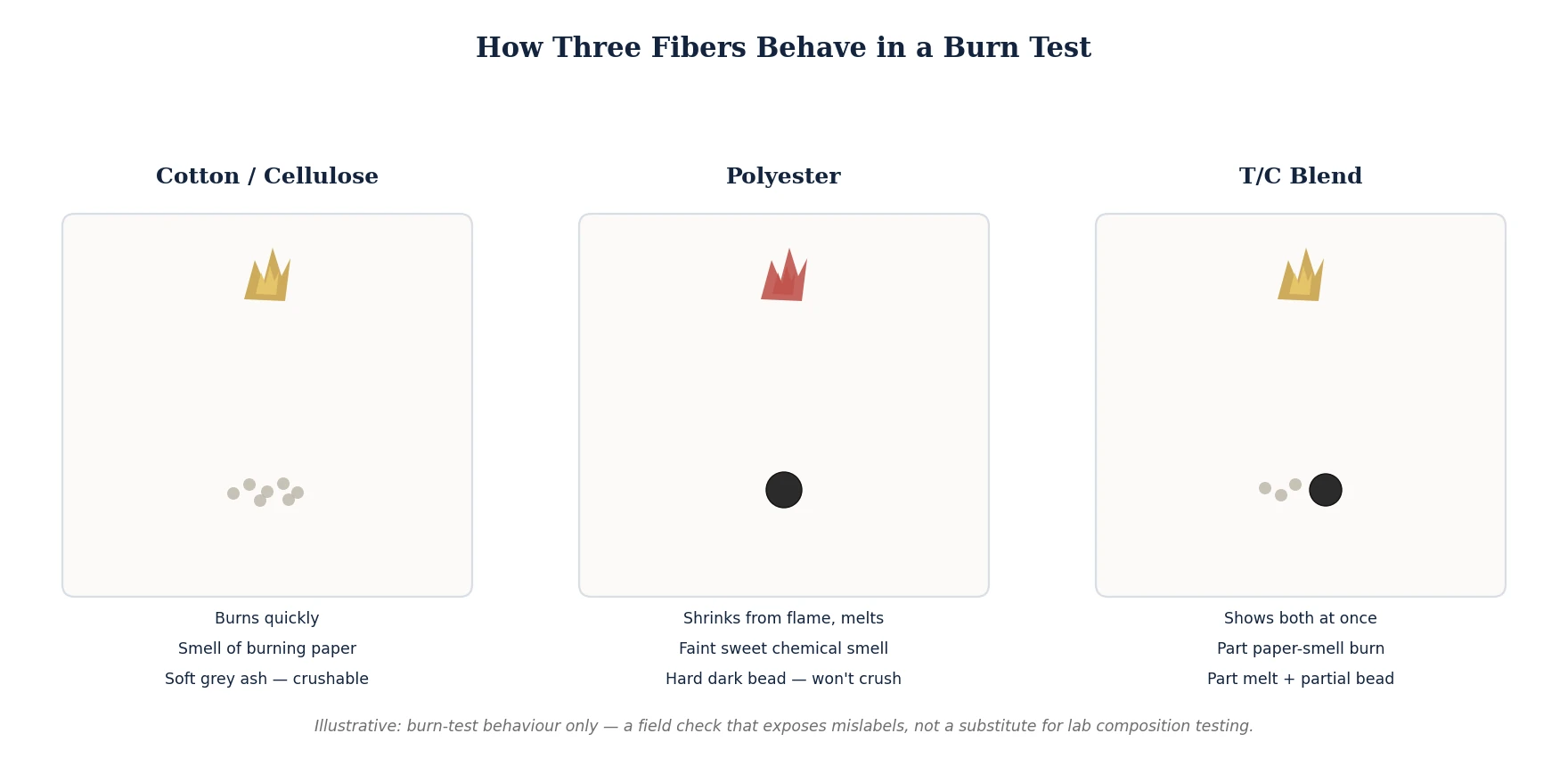
Cotton and other cellulose fibers (viscose, Tencel, bamboo) burn quickly with a smell like burning paper, and leave a soft, greyish ash you can crush between your fingers.
Polyester behaves completely differently: it shrinks away from the flame, melts before burning, gives off a faintly sweet chemical smell, and leaves a hard dark bead you cannot crush.
Wool and silk burn slowly, smell unmistakably of burning hair, and leave a brittle black residue.
A T/C blend shows both behaviors at once — some paper-smell burning plus melting and a partial hard bead. The burn test won’t tell you whether a blend is 65/35 or 60/40, but it instantly exposes the big lies: “cotton” that melts, or “pure polyester” pricing on what’s actually a blend.
What labs do that you can’t
Precise composition — the actual percentage split — is lab territory. Testing labs identify fibers under the microscope (cotton shows natural twists, wool shows surface scales, synthetics look like smooth rods) and use controlled solvent tests, where specific chemicals dissolve one fiber and leave the other, allowing the remaining fiber to be weighed. That weighing is how a lab certifies “65% polyester / 35% cotton” as a number rather than an opinion. These methods need trained hands and controlled conditions — which is exactly why composition claims on a test report carry weight that a supplier’s word doesn’t.
When to verify, and how to protect yourself
For routine repeat orders from a supplier you trust, a burn test on incoming goods is a reasonable spot check. For a first order, a new supplier, or any program where composition is specified in a contract, the professional move is third-party quantitative testing (SGS, Intertek, TÜV and similar) on a sealed sample before bulk — the cost is trivial next to a rejected shipment. Two habits make disputes nearly impossible: write the exact composition and its tolerance into your PO, and keep a retained sample from the approved lot so any later question has a physical reference.
At Yongbo Textile, composition is verified in our ISO 17025-accredited lab and stated plainly on every quotation — and we welcome third-party testing on any order, because the numbers hold up. 🌐 yongbotex.com