If a georgette, chiffon or satin drapes and whispers like silk but sits at a polyester price, chances are you’re looking at polyester that has been through a caustic bath. The soft, fluid hand isn’t woven in and it isn’t a coating — it comes from an alkali treatment the trade calls weight reduction (or caustic reduction). Understanding it matters, because the same process that produces a convincing silk substitute can also produce a fabric that splits at the seams if a mill overdoes it to chase a luxurious feel at the counter.
The silk-like hand comes out of a chemical bath, not the loom
Polyester is built from long chains held together by ester bonds. Drop the fabric into hot caustic soda (sodium hydroxide) and those bonds begin to break: the outer skin of each fiber dissolves away into the bath, leaving a thinner, more flexible filament behind. Strip away enough surface and the stiff, faintly plastic character of raw polyester turns into something soft and drapey.
Two levers control how far it goes. Caustic concentration sets the pace almost proportionally — more alkali, more fiber removed. Temperature is the other, and it’s less forgiving: polyester’s softening point sits near 81°C, and below that the reaction barely moves while above it the rate climbs fast. A few degrees of drift changes the outcome, which is exactly why this belongs in a mill with real process control rather than a general job shop.
The number that actually defines the fabric
How much fiber is dissolved away is expressed as the weight reduction rate, and it is the single spec that tells you what you’re buying:
- Around 5% loss, the surface is only lightly etched — the glassy shine is gone and the hand starts to relax, but the fabric is still fairly firm.
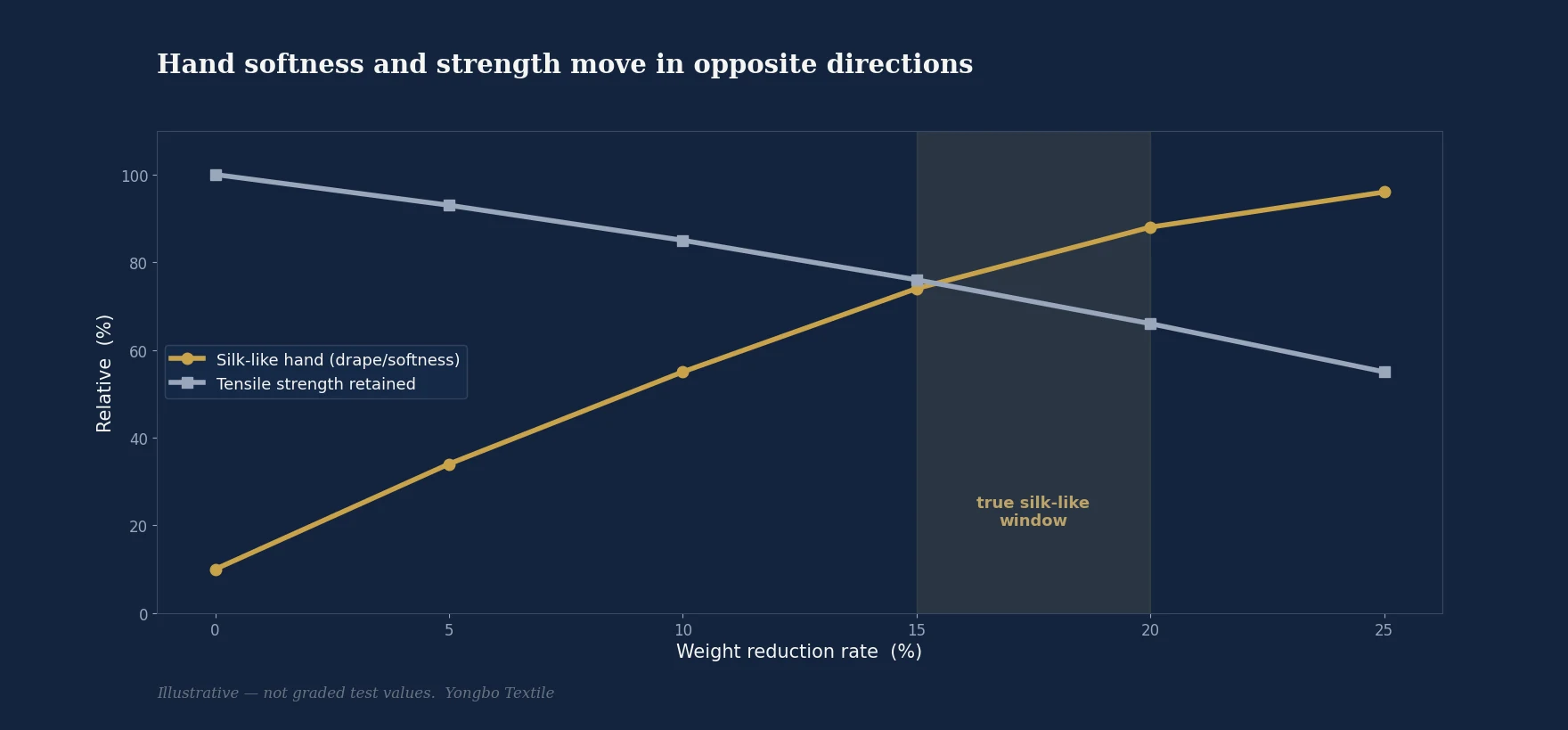
- In the 15–20% range, filaments are noticeably thinner, the weave loosens slightly, and the fabric picks up the soft flow and dry “scroop” people associate with real silk. This is the genuine silk-like window.
“We did alkali reduction” is not a specification — a 6% fabric and an 18% fabric are two different products with different hand, different strength and different cost. If the rate isn’t stated, you can’t compare quotes and you can’t predict performance.
Every bit of softness is borrowed from strength
Here’s the trade-off no honest supplier can dodge: the softer you make the fabric, the weaker it gets. Because reduction eats the fiber surface unevenly, it leaves microscopic pits that concentrate stress. Published testing shows tensile strength already slipping roughly 7% at only about 5% weight loss — and the decline continues as reduction climbs. Hand and strength sit on opposite ends of a seesaw, so a well-made silk-like polyester is a deliberately chosen balance point, not the maximum softness a bath can deliver. This is the same tension we cover in what silently weakens fabric during finishing — weight reduction is one of the clearest examples of it.
It also moves your color target
Reduction changes how the fabric dyes. A roughened, higher-surface-area fiber drinks up dye faster and deeper, which is good for rich shades — but push it too far and the pitted surface scatters so much light that colors read grey and shallow, and deep tones become impossible to hit. The practical consequence: the reduction rate has to be locked before color is approved. If you sign off lab dips first and the reduction process shifts afterward, the bulk shade will drift. We fix the reduction spec and the color standard together, in that order, so approvals hold in production.
What to put in front of any supplier before you approve
- Ask for the reduction rate in numbers, next to a strength figure. A serious mill can tell you both the target rate and the expected strength retention. If a supplier can offer one but not the other — or the two don’t reconcile — treat it as a flag.
- Insist the fabric isn’t over-reduced. Some yardage is pushed to extreme reduction purely to feel plush in the hand, then bursts at the seams in wear. Before bulk, have tear strength and seam strength run on the actual sample, not judged by touch alone.
- Write the rate into your price comparison. More reduction means more caustic, longer processing and more fiber lost — so it costs more. Comparing a lightly reduced fabric against a heavily reduced one on price alone compares two different things.
How to judge silk-like polyester without getting fooled
Hand feel is exactly how buyers get misled, because a bath can fake “luxurious” for the length of a showroom visit. Two checks cut through it: confirm the reduction rate on the spec sheet, and require strength data — tear and seam — on the specific quality you’re buying, before bulk. A supplier who runs the process themselves should be able to produce both without hesitation.
At Yongbo Textile, alkali weight reduction runs on our own dyeing and finishing lines in Jiaxing, so we set the reduction rate and the shade standard together and hold them through bulk. Tear, tensile and seam strength are tested per order on finished fabric in our ISO 17025 lab — not estimated from the greige — so silk-like polyester ships as a known quantity. For lightweight silk-like shells and linings, see our polyester pongee. 🌐 yongbotex.com